Maldives
Indian Ocean
Maldives
£2.50
Maldives: The Bay of Rays
While the Maldives is famous for luxury, for divers, it is the sanctuary of the Reef Manta Ray. The archipelago is home to the largest population of these graceful giants on the planet. During the southwest monsoon, a unique phenomenon occurs in places like Hanifaru Bay (Baa Atoll): plankton becomes trapped in the lagoon, triggering a "feeding frenzy." It is one of the only places on Earth where you can witness "cyclone feeding," where dozens—sometimes hundreds—of Mantas stack up in synchronized chains to gorge on the soup of life.
Why We Chose This Sticker Design
This design captures the synchronized beauty of a mass feeding event. We placed a majestic Reef Manta front and center, with its cephalic fins unrolled in "feeding mode" to funnel water into its mouth. To differentiate this from a standard portrait, the background features a "Manta Train"—a squadron of rays following the leader in a line, replicating the behavior seen during the famous Hanifaru feeding aggregations.
Diving Maldives
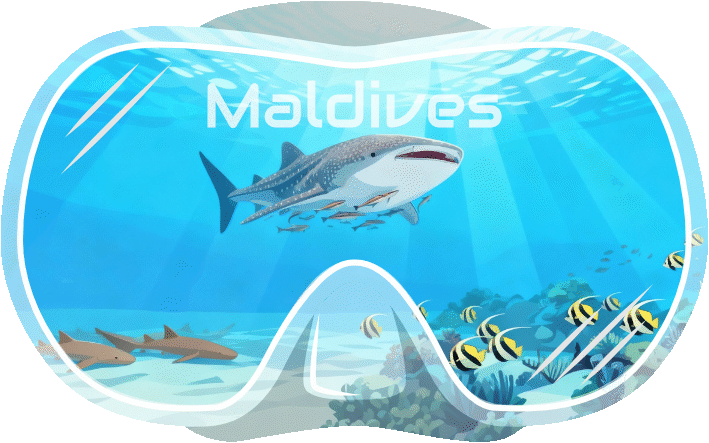
The Maldives is a chain of coral atolls where the diving is defined by water movement. Currents pour through the channels between islands, and divers hook in or drift while sharks, eagle rays and schooling fish hold station in the flow. Cleaning stations on submerged reefs draw reef mantas, and South Ari Atoll holds one of the few year-round whale shark populations in the world. Trips run either from a resort, diving a handful of nearby atolls, or by liveaboard, which covers far more ground.
- Best time to dive
- December to April for visibility; May to November for manta activity
- Difficulty
- Intermediate — channel diving means current
- Water temperature
- 27–30°C
- Visibility
- 15–30m, best in the drier months
Top dive sites
- •South Ari Atoll — Year-round whale shark territory
- •Hanifaru Bay, Baa Atoll — Seasonal manta feeding — snorkel only
- •Channel (kandu) dives — Hook in and watch sharks hold in the current
- •Thilas and giris — Submerged pinnacles with cleaning stations
What you’ll see
Frequently asked questions
When is the best time to dive the Maldives?
It splits by monsoon. The north-east monsoon from roughly December to April brings calmer seas and the clearest water, which is the classic season. The south-west monsoon from around May to November pushes more plankton through the atolls — visibility drops, but that plankton is exactly what draws manta rays and whale sharks, so it is the better window for big animals. Water stays at 27 to 30°C year-round either way.
Do I need experience to dive the Maldives?
Some, yes. The signature dives are channel dives where current is the whole point, and divers commonly use reef hooks to hold position while sharks pass. Most operators want Advanced Open Water or equivalent experience for those sites. That said, plenty of resorts have sheltered house reefs and gentle thilas suitable for newer divers, so it works as a destination at either level — just be clear about your experience so you are placed on appropriate sites.