British Columbia
USA/Canada
Canada
£2.50
British Columbia: The Emerald Sea
British Columbia is widely considered the best cold-water diving in the world, period. Known as the "Emerald Sea" because of its nutrient-rich, greenish tint, these waters are an explosion of life fueled by massive tidal exchanges. It is not a place for the casual swimmer; it is a drysuit destination where currents rip through narrow passes, feeding forests of Bull Kelp and soft corals. But the real draw is the "giants." From Stellar Sea Lions to Wolf Eels, everything here grows to massive proportions, making every dive feel like an expedition into a wild, oversized underwater jungle.
Why We Chose This Sticker Design
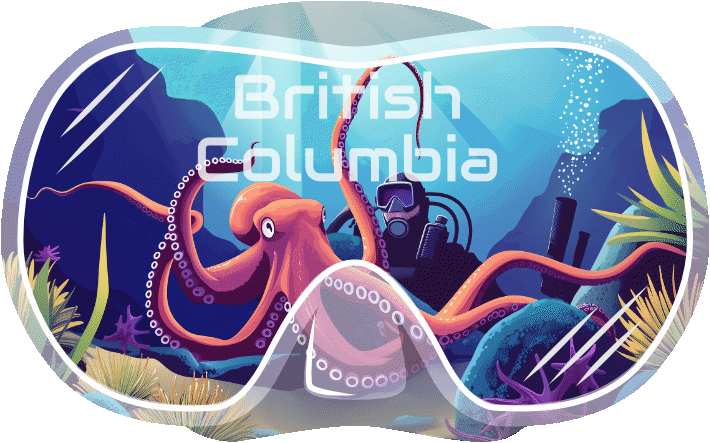
There is only one undisputed king of the PNW, and we had to put him front and center: the Giant Pacific Octopus. We illustrated this GPO with its tentacles sprawled out to capture that "alien intelligence" look that makes an encounter with them so unforgettable. We deliberately placed a diver in the background to provide a sense of scale, emphasizing just how massive these creatures can get. The color palette mixes deep, cold blues with vibrant oranges and purples to mimic the rich invertebrate life that covers every inch of the rocky walls here.
Diving British Columbia
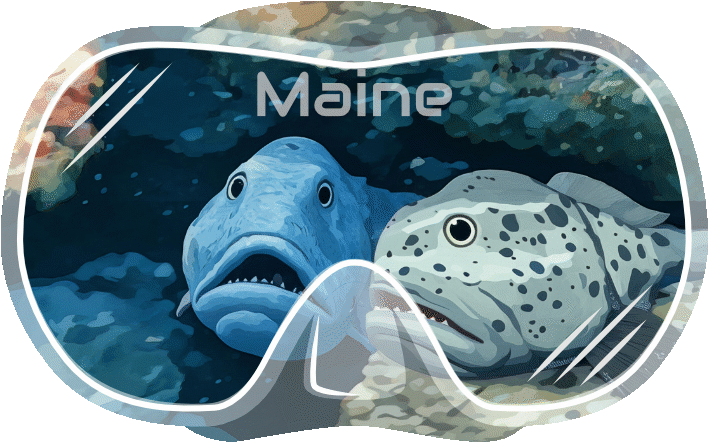
British Columbia offers some of the best cold-water diving in the world — a claim often attributed to Jacques Cousteau, who reportedly ranked it second only to the Red Sea. The draw is a mix of extraordinary invertebrate life and large, charismatic animals: giant Pacific octopus, the largest octopus species anywhere; wolf eels that peer out of crevices with almost human faces; and steller sea lions that show up in winter to harass divers in the best possible way. Counter-intuitively, winter is the season, when plankton dies back and visibility opens up dramatically.
- Best time to dive
- October to April — winter gives the clearest water
- Difficulty
- Advanced — cold, current and low light
- Water temperature
- 7–12°C — drysuit essential
- Visibility
- 10–30m in winter, far less in summer
Top dive sites
- •Hornby Island — Steller sea lions in winter
- •Browning Pass — Walls smothered in invertebrate colour
- •HMCS Saskatchewan — Artificial reef wreck near Nanaimo
- •Quadra Island — Current-swept reefs with cloud sponge
What you’ll see
Frequently asked questions
Why is winter the best time to dive British Columbia?
Because the plankton disappears. Through the summer, long days and nutrient-rich water drive blooms that can cut visibility to a few metres. Once the light drops in autumn the plankton dies back and the water clears dramatically, with 20 to 30 metres common in mid-winter. The water is cold year-round at 7 to 12°C, so summer offers little temperature advantage anyway — which is why local divers treat October to April as the real season.
What do I need to dive British Columbia?
A drysuit and the training to use it, plus proper thermal protection including dry gloves for most divers. Beyond exposure, the region is genuinely current-driven — many of the best sites are dived only at slack water — and dives are often dark and deep enough to warrant good lighting. Operators expect solid cold-water experience. If your diving has been warm and tropical, plan a couple of easier local dives before tackling the signature sites.