The Great Lakes
USA/Canada
USA
£2.50
The Great Lakes: The Time Capsules of the North
Forget colorful coral—diving the Great Lakes is about traveling back in time. These massive inland seas are arguably the best place on the planet for shipwreck enthusiasts who want to see history exactly as it was left. Because the water is cold, fresh, and salt-free, wooden schooners and steamers from the 1800s are perfectly preserved, often sitting upright with their masts still standing. It’s a haunting, silent world where you explore pristine "museums" on the bottom, free from the decay that eats away at ocean wrecks. This is diving for those who appreciate the eerie, majestic quiet of the sweetwater seas.
Why We Chose This Sticker Design
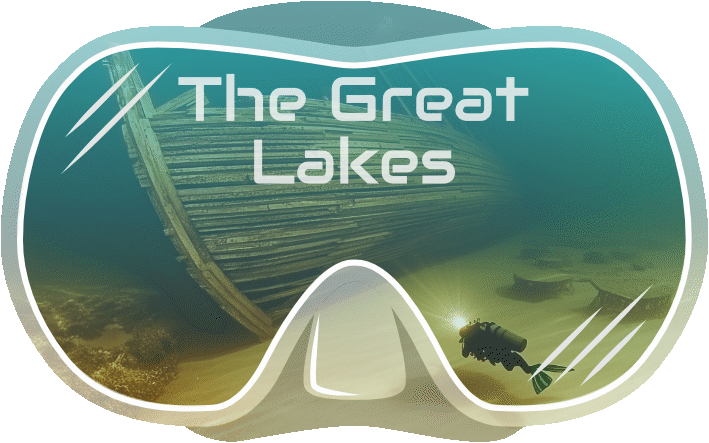
We wanted to capture the specific, moody atmosphere that defines freshwater diving. We swapped out our usual tropical palette for a spectrum of murkier emerald greens and silt-browns to mimic that distinct low-light visibility of the lakes. The focus of the illustration is the texture of the wooden hull, emphasizing how intact the planking remains underwater. We included a single diver with a beam of light to show scale, highlighting how these massive wooden skeletons loom out of the green gloom to greet you.
Diving The Great Lakes
The Great Lakes hold what are probably the best-preserved shipwrecks on earth. Cold fresh water means no shipworm and very little corrosion, so vessels lost a century or more ago still stand with masts up, rigging in place and paint on the hull — wrecks that would be unrecognisable rubble in salt water. Thunder Bay in Lake Huron and Fathom Five at Tobermory in Ontario are the best-known destinations, with wrecks ranging from shallow enough to snorkel to deep technical dives. Visibility is often excellent, and the water is very cold.
- Best time to dive
- July to September
- Difficulty
- Beginner to technical, depending on the wreck
- Water temperature
- 4–20°C — cold below the thermocline, drysuit advised
- Visibility
- 10–30m and sometimes more
Top dive sites
- •Fathom Five, Tobermory — Sweepstakes and Arabia — shallow to deep
- •Thunder Bay, Lake Huron — Marine sanctuary with around 100 wrecks
- •Isle Royale, Lake Superior — Remote, deep and exceptionally preserved
What you’ll see
Frequently asked questions
Why are Great Lakes shipwrecks so well preserved?
Cold fresh water. Salt water corrodes steel quickly and hosts shipworm, which destroys timber within decades. The Great Lakes have neither, and the deeper water stays close to 4°C year-round, so wooden schooners lost in the 1800s still stand intact with masts, deck fittings and even paint. It makes the region internationally significant for maritime archaeology, and it is why divers travel there specifically for wrecks rather than marine life.
Do I need technical training to dive the Great Lakes?
Not necessarily. Tobermory in particular has wrecks in very shallow water — the Sweepstakes sits in only a few metres and can be seen by snorkellers — and plenty of sites fall within recreational limits. That said, many of the most impressive wrecks are deep and cold, well into technical range, and require decompression training, redundant gas and appropriate thermal protection. There is a good progression available for divers wanting to work up.