California
USA/Canada
USA
£2.50
California: The Golden State’s Kelp Cathedrals
California diving is a spiritual experience. This is the home of the Giant Kelp forests—towering, amber-colored underwater jungles that can grow up to two feet a day. Diving here feels less like swimming and more like hiking through a submerged redwood forest. From the Channel Islands to Monterey, the nutrient-rich cold water supports an insane amount of biodiversity. It is one of the few places on Earth where you can weave through swaying fronds in the morning and play with sea lions in the afternoon. It’s cold, it’s wild, and it is absolutely magical.
Why We Chose This Sticker Design
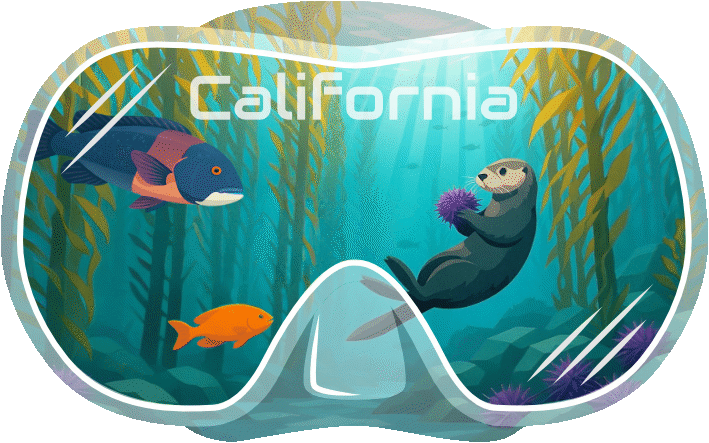
This might just be the most "Otterseas" sticker in the entire lineup! We obviously had to feature a Sea Otter as the main character, shown here cracking open a purple sea urchin—a classic behavior that actually helps keep the kelp forests healthy. But a California reef isn't complete without the locals, so we added the bright orange Garibaldi (the state marine fish!) and a male California Sheephead to capture that distinct mix of cold-water colors. The background is dominated by the vertical lines of the kelp forest, creating that signature depth and "cathedral" lighting that defines West Coast diving.
Diving California
California diving means kelp. Giant kelp grows in dense underwater forests along the coast and around the Channel Islands, rising from the rocky bottom to the surface and filtering the light into shafts — it is one of the most atmospheric environments in diving. The residents are just as good: bright orange garibaldi, harbour seals, and California sea lions that treat divers as entertainment. Monterey and the Channel Islands are the two hubs. The water is cold, so a drysuit or a serious wetsuit is the price of admission.
- Best time to dive
- September to November for the warmest water and clearest visibility
- Difficulty
- Intermediate — cold, surge and kelp navigation
- Water temperature
- 10–20°C — drysuit or 7mm
- Visibility
- 5–25m, best in autumn
Top dive sites
- •Channel Islands — Anacapa and Santa Cruz — the best kelp forests
- •Point Lobos, Monterey — Protected reserve, permit required
- •Monterey Breakwater — Easy shore dive with sea lions
- •Farnsworth Bank, Catalina — Advanced site with purple hydrocoral
What you’ll see
Frequently asked questions
When is the best time to dive in California?
Autumn — roughly September to November — is the sweet spot, when the water is at its warmest, plankton blooms have died back and visibility is at its best. Spring brings heavy plankton and murkier conditions, though the marine life is very active. Water ranges from about 10°C in the north in winter to around 20°C in southern California in late summer, so this is drysuit or thick-wetsuit diving whatever the month.
Is diving in a kelp forest difficult?
It takes a short adjustment rather than special training. Kelp is easy to move through if you go slowly and deliberately; entanglement problems come from thrashing. The standard advice is to swim through gaps rather than fight the stipes, keep gear streamlined, and if you do get caught, stop and calmly break the kelp — it snaps easily. Surface swims through thick kelp are best done on your back, kicking gently.