Hawaii
USA/Canada
USA
£2.50
Hawaii: The Isolated Kingdom
Hawaii is the most isolated population center on Earth, a chain of volcanic islands born from fire in the middle of the Pacific. For divers, it is a land of endemics—roughly 25% of the marine life found here exists nowhere else. But the true spirit of the islands is the "Honu" (Green Sea Turtle). These ancient navigators are more than just animals here; they are cultural icons, representing good luck and protection. Whether you are snorkeling off Maui or diving the lava tubes of the Big Island, the Honu is the constant companion of the Hawaiian diver.
Why We Chose This Sticker Design
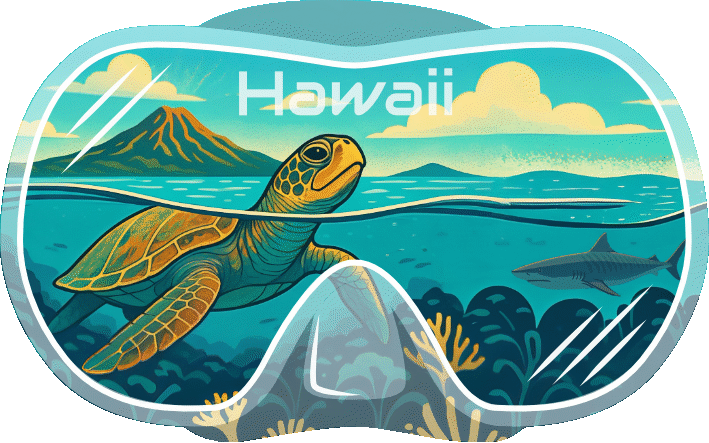
This design uses a split-shot composition to tell the full story of the archipelago. We centered the artwork on a Green Sea Turtle (Honu) taking a breath at the surface, bridging the gap between air and water. Above the waterline, we illustrated the iconic volcanic peaks that define the islands' geography. Below the surface, we included a patrolling Tiger Shark in the distance—the apex predator of these waters—swimming over a healthy volcanic reef.
Diving Hawaii
Hawaii's signature dive is the Kona manta ray night dive on the Big Island, and it is unlike anything else in diving: lights are set on the seabed to attract plankton, and reef mantas arrive to feed, barrel-rolling within centimetres of divers kneeling in a circle below. Kona is also one of the few places running blackwater dives, drifting at night over water thousands of metres deep to see bizarre pelagic larvae rising from the depths. Elsewhere, Maui's Molokini crater and Oahu's wrecks offer clear, warm, straightforward diving.
- Best time to dive
- Year-round; humpback whales December to April
- Difficulty
- Beginner to advanced; the manta night dive is easy and shallow
- Water temperature
- 23–28°C
- Visibility
- 20–30m
Top dive sites
- •Kona manta night dive — Reliable, shallow, and unlike any other dive
- •Kona blackwater dive — Night drift over deep ocean for pelagic larvae
- •Molokini Crater, Maui — Submerged crater rim with clear water
- •Oahu wrecks — YO-257 and Sea Tiger, both accessible
What you’ll see
Frequently asked questions
How reliable is the Kona manta ray night dive?
It is among the most consistent animal encounters in diving, with high success rates over a long period, though not guaranteed — these are wild reef mantas and some nights they simply do not come. The format is well established: divers kneel on sand at around 10 metres in a circle around lights that draw plankton, and the mantas feed above. It is shallow, calm and suitable for newly certified divers, and snorkellers watch from the surface.
What is blackwater diving?
A night dive conducted offshore over very deep water, tethered to a line hung beneath a drifting boat with lights attached. You float in open ocean with thousands of metres beneath you, watching the nightly vertical migration — larval fish, octopus, jellyfish and other tiny pelagic animals rising from the depths. Kona is one of the best-known places to do it. It requires good buoyancy and comfort in open water with no reference, so it is not a beginner dive.