Chuuk Lagoon
Pacific & Oceania
Micronesia
£2.50
Chuuk Lagoon: The Ghost Fleet of the Pacific
Chuuk Lagoon (formerly Truk Lagoon) is the Mecca of wreck diving. It is not just a dive site; it is a moment in history frozen in time. In 1944, Operation Hailstone sent dozens of Japanese warships and merchant vessels to the seafloor, creating the world's largest "ghost fleet." Today, these wrecks are intact underwater museums filled with artifacts—from gas masks and telegraphs to sake bottles—now covered in vibrant soft corals. It is a haunting, somber, and visually spectacular experience that sits at the very top of every wreck diver's bucket list.
Why We Chose This Sticker Design
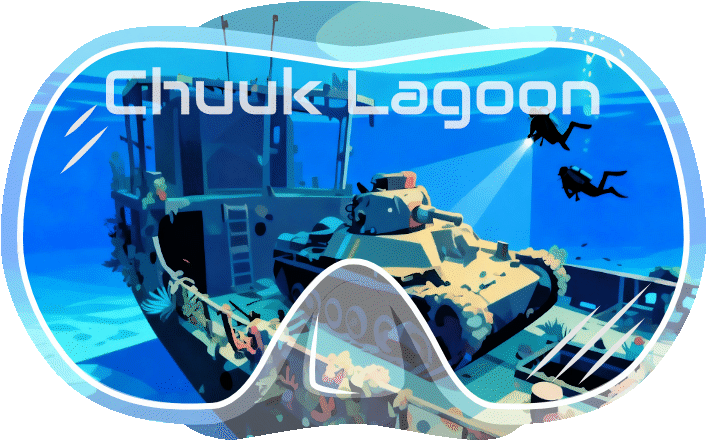
This design features the most iconic photo opportunity in the entire lagoon. We illustrated the deck of a sunken freighter—reminiscent of the legendary San Francisco Maru—showcasing a light tank resting perfectly upright on the structure. This specific imagery captures the surreal nature of Chuuk, where military machinery sits silently in the blue, reclaimed by the sea. We added divers with beams of light to emphasize the depth and the thrill of exploring these massive steel giants.
Diving Chuuk Lagoon
Chuuk Lagoon — long known as Truk — holds the largest concentration of shipwrecks on earth. In February 1944, a two-day US carrier assault codenamed Operation Hailstone caught the Japanese fleet at anchor and sank around fifty ships and hundreds of aircraft. They lie in warm, sheltered water from 10 metres to well past 60, holds still packed with trucks, aircraft parts, munitions and personal effects, and coral now growing over everything. Many of the wrecks contain human remains and are treated as war graves, which shapes how they are dived.
- Best time to dive
- Year-round; December to April tends to be calmest
- Difficulty
- Advanced to technical — depth, penetration, and nitrox or trimix
- Water temperature
- 28–30°C
- Visibility
- 10–30m
Top dive sites
- •Fujikawa Maru — The classic — aircraft fuselages in the holds
- •Shinkoku Maru — Beautifully coral-encrusted tanker
- •San Francisco Maru — Deep wreck with tanks on deck — technical
- •Nippo Maru — Cargo including a tank and artillery
What you’ll see
Frequently asked questions
What qualifications do I need for Chuuk Lagoon?
It depends how deep you want to go. Several wrecks have decks and superstructure within recreational range, so an Advanced Open Water diver can enjoy a good portion of the lagoon, ideally with nitrox and wreck training. The deeper wrecks, including San Francisco Maru at around 50 to 60 metres, are firmly technical dives requiring decompression training and mixed gas. Serious penetration into holds and engine rooms needs proper wreck certification regardless of depth.
Are the Chuuk wrecks war graves?
Yes. Thousands of Japanese sailors died in the attack, and human remains are still present on several wrecks. They are treated with the respect that implies: do not touch, move or photograph remains, do not remove artefacts, and follow your guide’s briefing on which areas are off limits. Local authorities and operators take this seriously. Diving Chuuk is a genuinely moving experience partly because that history is so tangible and so unsanitised.