Great Barrier Reef
Pacific & Oceania
Australia
£2.50
Great Barrier Reef: One of the Seven Natural Wonders
The Great Barrier Reef is more than just a destination; it is a global icon. As one of the Seven Natural Wonders of the World, this massive living structure stretches over 2,300 kilometers and is famously the only living thing on Earth visible from space. It is the heavyweight champion of biodiversity, offering everything from microscopic pygmy seahorses to massive Potato Cod and Dwarf Minke Whales. Diving here feels like swimming inside a high-definition nature documentary—vibrant, infinite, and the absolute standard by which all other tropical reefs are measured.
Why We Chose This Sticker Design
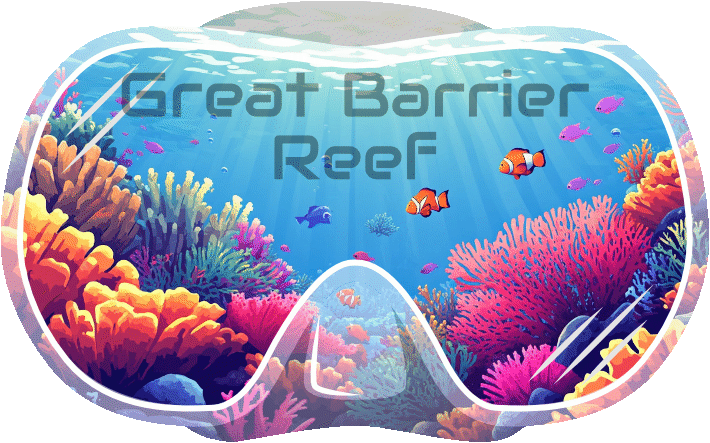
This design serves as our visual love letter to the world's largest reef system. We packed the frame with dense layers of intricate hard corals and swaying soft fans to mimic the chaotic, bustling energy of a healthy ecosystem. To complete the scene, we featured a trio of bright orange Clownfish darting through the crystal-clear blue, adding that splash of life that everyone hopes to see on a GBR dive. It is a vibrant celebration of the neon colors that define this underwater masterpiece.
Diving Great Barrier Reef
The Great Barrier Reef stretches some 2,300 kilometres along the Queensland coast and remains the largest reef system in the world. Day boats and liveaboards run from Cairns and Port Douglas to the outer reef, where visibility is far better than the inshore sites, and the Ribbon Reefs to the north hold the best-known dives — including the Cod Hole, with its enormous resident potato cod. Dwarf minke whales appear on the northern reefs in mid-winter. The reef has suffered repeated mass bleaching events since 2016, and condition now varies a great deal between sites.
- Best time to dive
- June to October — dry season, best visibility
- Difficulty
- Beginner to intermediate
- Water temperature
- 22–29°C
- Visibility
- 15–30m on the outer reef
Top dive sites
- •Cod Hole, Ribbon Reefs — Resident potato cod, encountered up close
- •Osprey Reef — Coral Sea seamount with sharks and steep walls
- •SS Yongala — Outstanding wreck further south, off Townsville
- •Agincourt Reefs — Outer-reef coral gardens from Port Douglas
What you’ll see
Frequently asked questions
When is the best time to dive the Great Barrier Reef?
June to October, the Queensland dry season, gives the clearest water and the most settled weather. It also coincides with dwarf minke whale season on the Ribbon Reefs, which peaks around June and July. The wet season from November to May brings warmer water but more rain, run-off and reduced visibility, and it is also stinger season — box jellyfish and Irukandji are present in coastal waters, so operators provide full-body stinger suits.
Has bleaching damaged the Great Barrier Reef?
Yes, significantly. The reef has been hit by repeated mass bleaching events since 2016, driven by marine heatwaves, and coral cover has declined sharply in some regions while other areas have partially recovered. The honest picture is that condition varies enormously between sites: outer-reef and Coral Sea locations generally look far better than inshore reefs. It is still an extraordinary place to dive, but it is not the uniformly pristine reef older documentaries show.