French Polynesia
Pacific & Oceania
French Polynesia
£2.50
French Polynesia: The World’s Largest Shark Sanctuary
French Polynesia isn't just a dive destination; it is a 4-million-square-kilometer safe haven for apex predators. In 2006, the entire country was declared a shark sanctuary, which means when you dive here—whether it’s the adrenaline-fueled passes of Fakarava or the crystal lagoons of Moorea—you are stepping into a world ruled by sharks. It is one of the only places on Earth where you can see a "wall" of hundreds of Grey Reef Sharks hanging in the current, or snorkel in waist-deep water while dozens of Blacktips circle your ankles. It is wild, protected, and absolutely thriving.
Why We Chose This Sticker Design
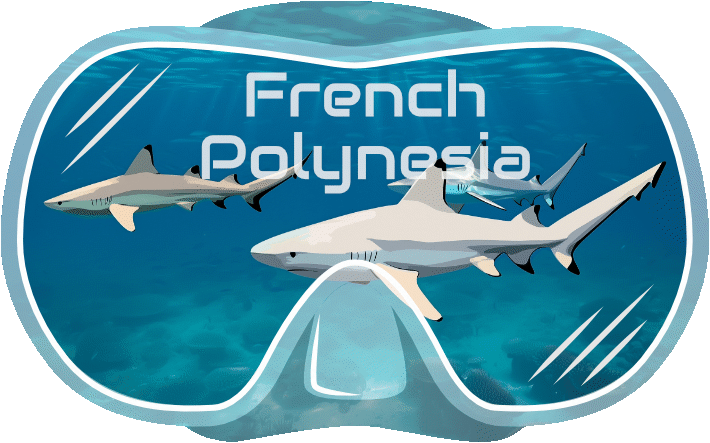
The visual identity of French Polynesia is defined by the constant, graceful presence of Blacktip Reef Sharks, so we centered the artwork on a shiver of them patrolling the reef. We illustrated their sleek, classic silhouettes against a backdrop of pure, gradient blue to mimic the insane visibility found inside the atolls. The composition focuses on their distinct black-tipped fins and casual swimming style to capture the feeling of being completely surrounded by these elegant predators in a pristine, endless lagoon.
Diving French Polynesia
French Polynesia's diving happens in the passes — the channels cutting through atoll rims where ocean water floods in and out with the tide, carrying sharks with it. Fakarava's south pass is the most famous, holding hundreds of grey reef sharks in a single wall of animals, and the numbers swell further during the grouper spawning in mid-winter. Rangiroa's Tiputa Pass adds dolphins that surf the incoming current. Water is warm and clear, the terrain is straightforward, and the current does most of the work — but it demands respect.
- Best time to dive
- April to October, the drier season
- Difficulty
- Advanced — pass diving with strong tidal current
- Water temperature
- 26–29°C
- Visibility
- 30–40m
Top dive sites
- •Fakarava South Pass — The wall of sharks — hundreds of grey reefs
- •Tiputa Pass, Rangiroa — Dolphins, sharks and a fast incoming drift
- •Fakarava North Pass — Wider, gentler pass with plenty of shark traffic
- •Tikehau — Quieter atoll with manta cleaning stations
What you’ll see
Frequently asked questions
When is the best time to dive Fakarava?
April to October is the drier season with the most comfortable conditions. The stand-out event is the marbled grouper spawning aggregation around June and July, which draws enormous numbers of sharks into the south pass and is one of the great wildlife spectacles in diving — it is also the busiest time, so book well ahead. Outside that, the shark wall is present year-round; pass dives are timed to the incoming tide whatever the month.
How difficult is pass diving in the Tuamotus?
Demanding but manageable with the right experience. Dives are timed for the incoming tide, when clear ocean water floods the pass, and the current can move fast enough that the dive is essentially a long drift with little finning. You need to be comfortable with negative entries, staying close to a group in moving water, and deploying an SMB for pickup. Operators generally require Advanced Open Water and recent current experience.