Japan
Pacific & Oceania
Japan
£2.50
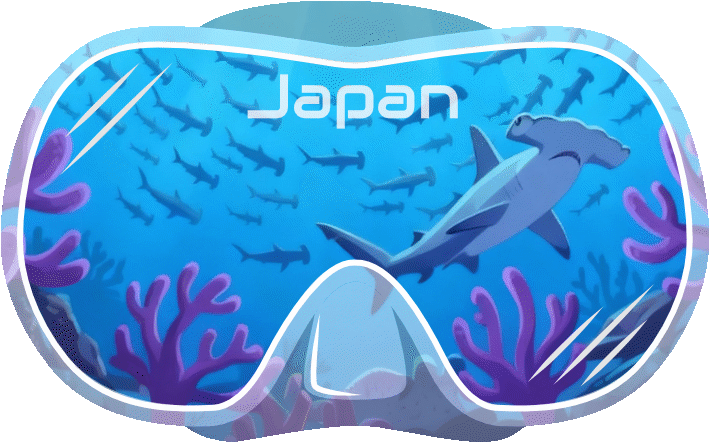
Japan: The Hammerhead River
Most people think of Japan for its sushi and snow, but underwater, it hosts one of the world's most impressive shark spectacles. Off the coast of the Izu Peninsula lies Mikomoto Island, a place frequently nicknamed the "Cocos of Japan." Here, the powerful Kuroshio Current brings warm water and massive schools of Scalloped Hammerheads. It is a high-adrenaline drift dive where you can see hundreds of sharks forming a literal river in the blue. It is wild, current-swept, and totally unexpected for a destination usually known for its macro life.
Why We Chose This Sticker Design
The visual anchor for this piece is the phenomenon known as the "Hammerhead River." We painted a dense wall of silhouetted sharks in the background to replicate that awe-inspiring moment when the school blocks out the sun. To contrast with the deep blue, we framed the bottom with vibrant purple soft corals, which are characteristic of the rocky, nutrient-rich reefs found in Japanese waters. The result is a design that balances the delicate beauty of the reef with the raw power of the open ocean.
Diving Japan
Japan spans a huge latitude range, so its diving is genuinely varied. The subtropical Kerama Islands off Okinawa give clear, warm water and healthy coral, with humpback whales passing in late winter. Yonaguni, at the far western end of the country, is known for a controversial submerged rock formation and for schooling hammerheads in the cold months. On the other extreme, Hokkaido offers drift-ice diving in February and March, where divers enter beneath pack ice to look for the tiny sea angels that drift among it.
- Best time to dive
- Varies by region — Okinawa year-round, Hokkaido ice diving in February and March
- Difficulty
- Beginner to advanced depending on region
- Water temperature
- 14–29°C depending on latitude and season
- Visibility
- 15–30m
Top dive sites
- •Kerama Islands, Okinawa — Clear subtropical water and healthy coral
- •Yonaguni Monument — Submerged rock formation; hammerheads in winter
- •Izu Peninsula — Accessible diving close to Tokyo
- •Shiretoko, Hokkaido — Drift-ice diving in late winter
What you’ll see
Frequently asked questions
Where is the best diving in Japan?
It depends what you want. Okinawa and the Kerama Islands offer the classic warm-water diving — clear, coral-rich and accessible year-round. Ishigaki is known for manta cleaning stations. Yonaguni draws divers for its submerged rock formation and winter hammerheads. For something completely different, Hokkaido runs drift-ice diving in February and March. The Izu Peninsula near Tokyo is the most convenient option for a short trip.
What is the Yonaguni Monument?
A large submerged sandstone formation off Yonaguni Island with flat terraces, straight edges and step-like features. Some argue it is a man-made structure from a lost civilisation; most geologists consider it a natural formation shaped by fracturing along bedding planes, which is the mainstream view. Either way it is a striking dive. It is exposed, current-swept and usually dived in the winter months, which is also when hammerheads school in the area.