Solomon Islands
Pacific & Oceania
Soloman Islands
£2.50
Solomon Islands: The Iron Bottom Sound
The Solomon Islands offer one of the most atmospheric diving experiences on the planet. This region, particularly the waters around Guadalcanal, was the stage for some of the fiercest naval battles of World War II. Today, the seabed is so littered with sunken warships and aircraft that it is famously known as "Iron Bottom Sound." But this isn't a graveyard; it is a thriving living museum. Over the last 80 years, the ocean has reclaimed these weapons of war, turning jagged metal into lush artificial reefs teeming with life. It is a haunting, beautiful destination where history and nature are perfectly fused.
Why We Chose This Sticker Design
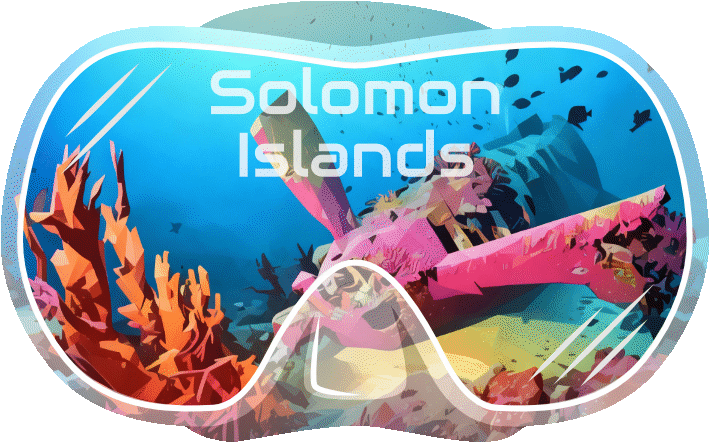
To capture the unique spirit of the Solomons, we focused on the beauty of decay. The centerpiece of the design is a World War II fighter plane resting on the seabed, but it is no longer a machine of war—it is a part of the reef. We illustrated the fuselage heavily encrusted in pink and purple coralline algae to show how nature has taken over. To complete the scene, we framed the wreck with vibrant orange branching corals, representing the pristine health of the surrounding reefs in this remote corner of the Coral Triangle.
Diving Solomon Islands
The Solomon Islands combine dense coral reefs with some of the most accessible WWII wreckage in the Pacific. The waters off Guadalcanal — Iron Bottom Sound — earned their name from the sheer number of ships lost there in 1942 and 1943, and two of them, the Bonegi wrecks, are shallow enough to reach from the beach. Elsewhere the country offers barrier reefs, lagoons, caves and fighter aircraft sitting upright on the seabed. Diver numbers are low, infrastructure is limited, and that combination is precisely the appeal.
- Best time to dive
- April to November
- Difficulty
- Intermediate — remote, with limited facilities
- Water temperature
- 27–30°C
- Visibility
- 15–30m
Top dive sites
- •Bonegi I & II — WWII transports reachable from the shore
- •Iron Bottom Sound — Wrecks and aircraft from the Guadalcanal campaign
- •Marovo Lagoon — Vast lagoon system with healthy reef
- •Leru Cut, Russell Islands — Narrow chasm with dramatic light shafts
What you’ll see
Frequently asked questions
What is diving in the Solomon Islands like?
Varied and very quiet. You can dive a WWII transport from the beach in the morning and a pristine barrier reef in the afternoon, usually without seeing another dive group. Coral condition is generally excellent, and the mix of wreckage, reef, caves and lagoon gives real variety. The trade-off is infrastructure — flights are limited, some areas have few operators, and liveaboards cover the more remote regions better than land-based resorts do.
Can you dive the WWII wrecks from shore?
Some of them, which is unusual. The Bonegi wrecks on Guadalcanal — two Japanese transports beached during the 1942 campaign — lie close enough to the shore that you can walk in and swim out to them, with sections in very shallow water. Other wrecks and downed aircraft across Iron Bottom Sound sit far deeper, well into technical range, and are usually left to specialist teams. Many of these sites are war graves and are treated accordingly.