Palau
Pacific & Oceania
Palau Archipelago
£2.50
Palau: The Golden Lake
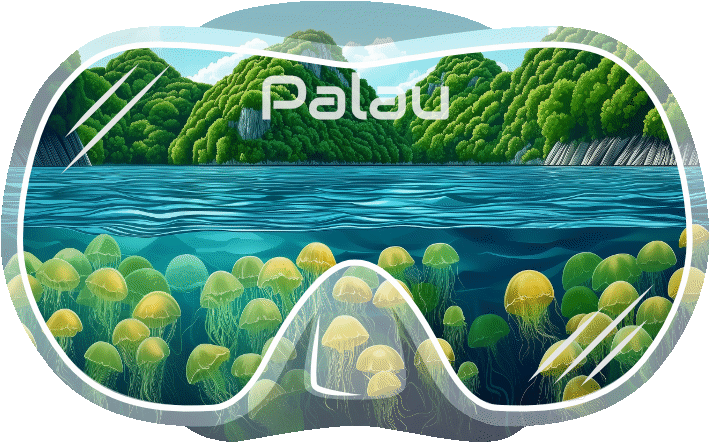
While Palau is famous for the shark-infested currents of Blue Corner, its most surreal attraction is hidden inside one of its limestone islands. Jellyfish Lake (Ongeim'l Tketau) is a marine marvel where millions of Golden Jellyfish migrate across the water every day to follow the sun. Cut off from the ocean for millennia, these jellies have effectively lost their sting, allowing snorkelers to swim safely through a pulsing cloud of golden orbs. It is a quiet, hypnotic experience that feels less like swimming and more like floating through a living lava lamp.
Why We Chose This Sticker Design
This design captures the complete essence of the Rock Islands Southern Lagoon. We used a split-shot composition to tell the full story: above the waterline, the iconic mushroom-shaped limestone islands rise from the sea, covered in dense jungle. Below the surface, we illustrated the density of the Golden Jellyfish, showing them in various sizes to replicate the feeling of being surrounded by the swarm in their sun-dappled world.
Diving Palau
Palau, in the western Pacific, built its reputation on current-driven wall diving and sharks. At Blue Corner — routinely voted among the world's best dives — you hook into the reef edge and watch grey reef sharks, jacks and barracuda hold station in the flow. German Channel has a manta cleaning station, Ulong Channel is a fast, beautiful drift, and the islands are scattered with WWII wrecks and caves. Palau also created the world's first shark sanctuary in 2009, and the shark numbers show it.
- Best time to dive
- Year-round; November to April is drier
- Difficulty
- Advanced — reef hooks and strong current are standard
- Water temperature
- 28–30°C
- Visibility
- 20–40m
Top dive sites
- •Blue Corner — Hook in on the reef edge and watch the sharks
- •German Channel — Manta cleaning station on a sandy channel
- •Ulong Channel — Long, fast drift through a coral-lined cut
- •Blue Holes — Cathedral-like chambers opening onto the wall
What you’ll see
Frequently asked questions
Do I need a reef hook to dive Palau?
For the signature sites, yes — a reef hook is standard equipment here and most operators supply or sell them. At Blue Corner and similar sites you hook into dead reef or rock at the edge of the drop-off, inflate slightly, and hang in the current watching the action rather than finning against it. It is a specific skill: hooking safely without damaging live coral, and unhooking cleanly to drift off. Your guide will brief it, but practise the concept before you go.
How experienced should I be to dive Palau?
Reasonably. The best sites are current-driven walls and channels where conditions can change quickly, and operators typically ask for Advanced Open Water with recent experience. Good buoyancy, comfort with negative entries and confidence in moving water all matter more than a specific card. Palau does have gentler sites — the inner lagoon, wrecks and shallow reefs — so less experienced divers can build up, but the trip is best enjoyed with current diving already under your belt.