Baja California
Latin America
Mexico
£2.50
Baja California: The Aquarium of the World
Baja California is where the desert crashes into the sea, creating one of the most biologically diverse marine environments on the planet. Jacques Cousteau didn't call it the "Aquarium of the World" for nothing! While it is famous for everything from Grey Whales to Sea Lions, nothing beats the Mobula Ray aggregations. Every year, tens of thousands of these "flying rays" gather in the Sea of Cortez, performing acrobatic leaps that look like popcorn popping on the surface. It is a loud, chaotic, and absolutely magical natural phenomenon that proves you don't always need a tank to see the best action.
Why We Chose This Sticker Design
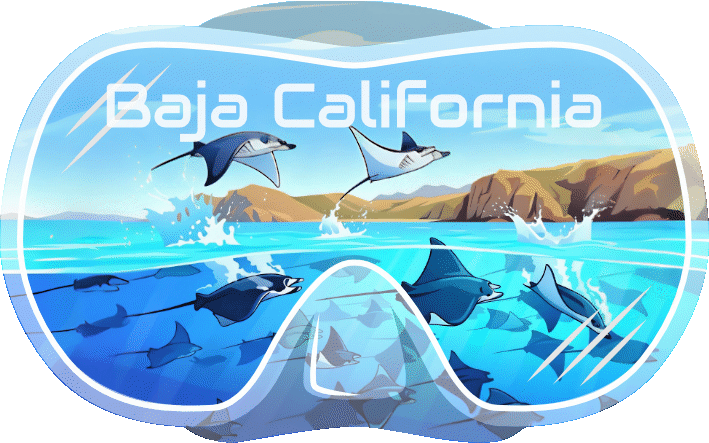
To really tell the story of the Mobula migration, we knew a standard underwater shot wouldn't cut it—we needed a split-shot. Above the waterline, we illustrated the rays breaching against that classic, rugged Baja desert coastline, capturing the "flying" behavior that makes them so famous. Below the surface, we showed the density of the school gliding through the electric blue water, creating a seamless connection between the arid landscape above and the teeming life below. It is a design that celebrates the wild, untamed contrast of the Baja peninsula.
Diving Baja California
Baja California separates the Pacific from the Sea of Cortez, the body of water Jacques Cousteau reportedly called the world's aquarium. It is a big-animal coastline: sea lion colonies where juveniles play with divers, whale sharks feeding in the shallows of La Paz Bay in winter, mobula rays massing in spring, and grey whales calving in the Pacific lagoons. Water clarity peaks in autumn, when the Sea of Cortez is warmest. Diving ranges from very easy sea lion snorkels to serious offshore trips.
- Best time to dive
- August to November for the warmest, clearest water; whale sharks October to April
- Difficulty
- Beginner to advanced depending on site
- Water temperature
- 18–29°C — a 5mm outside late summer
- Visibility
- 10–30m, best in autumn
Top dive sites
- •Los Islotes — Sea lion colony near La Paz
- •La Paz Bay — Whale shark snorkelling in winter
- •Cabo Pulmo — Recovered marine park with huge jack schools
- •Gordo Banks — Offshore seamount with hammerheads
What you’ll see
Frequently asked questions
When is the best time to dive Baja California?
August to November gives the warmest water — up to about 29°C in the Sea of Cortez — and the best visibility of the year. Whale shark season in La Paz Bay runs roughly October to April, and it is snorkel-based in shallow, often murky water. Mobula rays aggregate in spring. Winter is cooler at around 18 to 21°C with more wind, but brings whale migration along the Pacific side, so the right season depends entirely on the animal you want to see.
Can you still cage dive with great whites at Guadalupe Island?
Not currently. Guadalupe Island was for years the premier great white cage diving destination, prized for exceptional visibility, but Mexican authorities suspended the activity there from early 2023 on conservation grounds and it has not reopened as a normal commercial operation. Anyone selling a Guadalupe trip should be questioned closely. Divers wanting great whites now generally look to South Australia or South Africa instead.