Darwin & Wolf
Latin America
Ecuador
£2.50
Darwin & Wolf: The Sharkiest Place on Earth
For divers, the names "Darwin" and "Wolf" are sacred. Located in the far north of the Galapagos archipelago, these two remote islands are the absolute pinnacle of high-voltage diving. This is not a casual swim; it is a washing machine of currents that attracts the biggest animals in the ocean. We are talking about walls of Scalloped Hammerheads so dense they block out the sun, and massive, bus-sized Whale Sharks cruising by like they own the place. It is raw, it is wild, and it is widely considered the best big-animal diving on the planet.
Why We Chose This Sticker Design
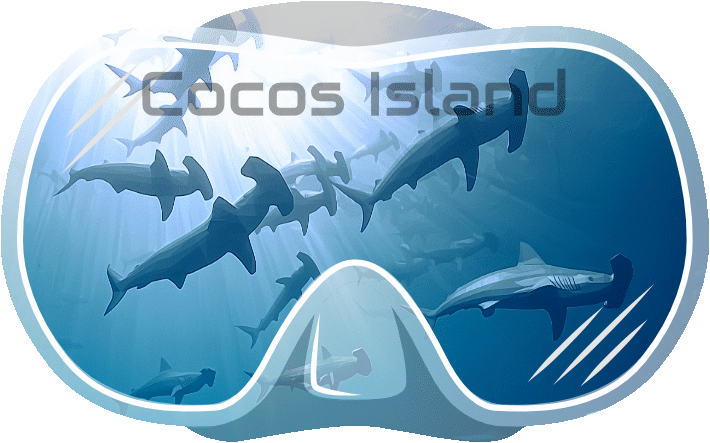
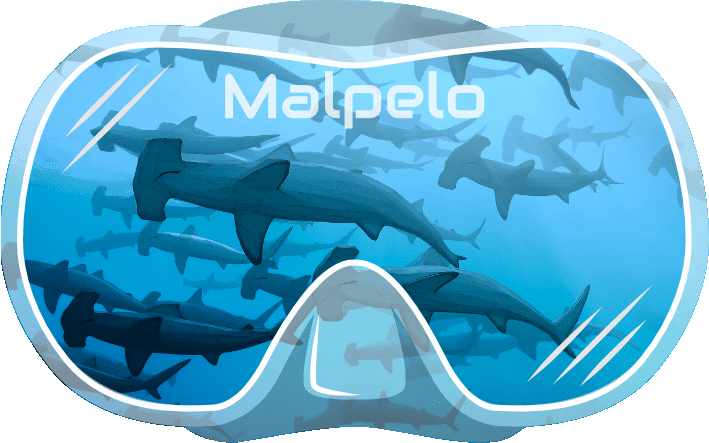
You can’t capture the scale of this location without a split-shot. Topside, we featured the legendary rock formation of Darwin’s Arch (now the Pillars of Evolution), the sentinel that marks the spot. But the real show is below, so we devoted the rest of the mask to the titans. We illustrated a massive Whale Shark gliding through the blue because seeing these gentle giants here is the ultimate prize. Beneath it, we filled the deep with the silhouettes of hundreds of Hammerheads, recreating that feeling of being completely surrounded by apex predators.
Diving Darwin & Wolf
Darwin and Wolf are two remote volcanic islands in the far north of the Galápagos, and they hold the greatest shark biomass recorded anywhere on the planet. Diving here means hanging onto rock in surging current while schools of scalloped hammerheads pass overhead in their hundreds, with whale sharks cruising through in the cool season. They lie roughly fourteen hours' sailing from the central islands, so access is by liveaboard only, and conditions are demanding enough that operators set firm experience requirements.
- Best time to dive
- June to November for whale sharks; hammerheads year-round
- Difficulty
- Advanced to expert — surge, strong current, open ocean
- Water temperature
- 18–26°C with sharp thermoclines
- Visibility
- 10–25m
Top dive sites
- •Darwin — The main shark site; the natural arch collapsed in 2021
- •Wolf — Landslide — Hammerhead schools along the wall
- •Wolf — Shark Bay — Reliable shark traffic in the current
What you’ll see
Frequently asked questions
Can you still dive Darwin’s Arch?
The dive site is still run, but the arch itself is gone — the natural rock bridge collapsed in May 2021, leaving two pillars standing on the platform. What made the site extraordinary was always the underwater topography and the currents that funnel sharks past it, and that is unchanged. Liveaboards continue to dive Darwin as the centrepiece of northern Galápagos itineraries; only the famous surface photograph is no longer possible.
How experienced do I need to be for Darwin and Wolf?
Genuinely experienced. Operators typically require Advanced Open Water with 50 to 100 logged dives, and want recent cold-water and current experience. Dives involve negative entries into moving water, holding position on rock in surge while sharks pass, and drifting off into blue water for pickup. Thermoclines can drop the temperature sharply mid-dive. This is not a place to gain current experience; it is a place to arrive already having it.