Galapagos Archipelago
Latin America
Ecuador
£2.50
Galapagos Archipelago: Darwin's Playground
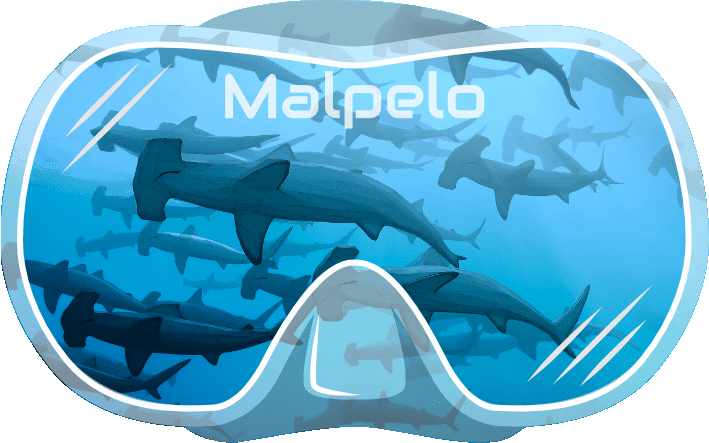
The Galapagos Islands are not just a dive destination; they are a pilgrimage. Located at the confluence of three major ocean currents, this archipelago is a crucible of evolution where life has taken strange and wonderful forms found nowhere else on Earth. While famous for massive schools of Scalloped Hammerheads and Whale Sharks, the real magic often lies in the oddities—creatures that look like they were assembled from spare parts. It is a place where penguins swim over coral reefs, iguanas graze underwater, and fish decide to walk instead of swim.
Why We Chose This Sticker Design
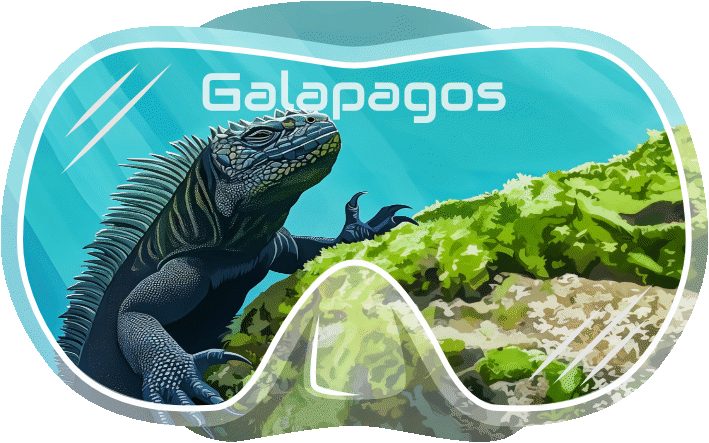
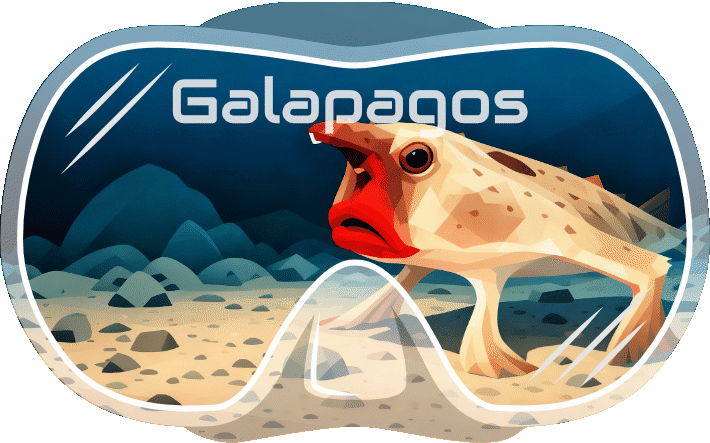
You can’t talk about Galapagos oddities without this star. We bypassed the sharks to feature the Red-lipped Batfish, arguably the strangest resident of the archipelago. We illustrated this endemic bottom-dweller in its natural habitat on the sandy seafloor, highlighting the "legs" (modified pectoral fins) that it uses to walk across the bottom. The focus, of course, is on the bright red mouth—a splash of color that looks like a bad lipstick job—set against the dark volcanic backdrop.
Diving Galapagos Archipelago
The Galápagos dives unlike anywhere else because of its currents. Cold, nutrient-rich water wells up around the archipelago and supports an improbable mix of tropical and cold-water species — you can see hammerhead schools, marine iguanas grazing algae underwater and penguins on the same trip. Central island sites are reachable on day trips from Santa Cruz and San Cristóbal, but the diving the islands are famous for is at Darwin and Wolf in the far north, which is liveaboard territory only.
- Best time to dive
- June to November for whale sharks; December to May is warmer and calmer
- Difficulty
- Advanced — cold thermoclines, strong current and surge
- Water temperature
- 18–26°C, colder in the cool season — a 5–7mm suit
- Visibility
- 10–25m, plankton-dependent
Top dive sites
- •Darwin — The famous hammerhead and whale shark site
- •Wolf — Shark-heavy walls and pinnacles
- •Gordon Rocks — Day-trip site from Santa Cruz with hammerheads
- •Cabo Marshall — Manta rays along the Isabela coast
What you’ll see
Frequently asked questions
When is the best time to dive the Galápagos?
It splits into two seasons. June to November is the cool, nutrient-rich season when currents bring plankton, water drops to around 18 to 22°C and whale sharks — mostly large adult females — visit Darwin. Seas are rougher and visibility patchier. December to May is warmer at 23 to 26°C with calmer crossings and better visibility, still with plenty of hammerheads. Neither is wrong; pick according to whether whale sharks or comfort matter more.
Do I need a liveaboard for the Galápagos?
For Darwin and Wolf, yes — they lie far to the north of the main group and are only reachable by liveaboard, on itineraries that must be booked well in advance because permits are limited. The central islands have good diving accessible on day trips from Santa Cruz and San Cristóbal, including Gordon Rocks, and that is a cheaper way to visit. But the shark aggregations the Galápagos is famous for are at the northern islands.