Socorro
Latin America
Mexico
£2.50
Socorro: The Friendliest Giants in the Ocean
The Revillagigedo Archipelago—commonly known as Socorro—is the "Jurassic Park" of the Mexican Pacific. It is a remote, wild frontier located 240 miles offshore, but divers make the long journey for one specific reason: the Giant Oceanic Manta Rays. Unlike anywhere else on Earth, the mantas here actively seek out interaction. They don't just swim by; they hover over divers, soaking up the bubbles on their bellies and looking you straight in the eye. It is widely considered the best place in the world to dance with these massive, intelligent aliens.
Why We Chose This Sticker Design
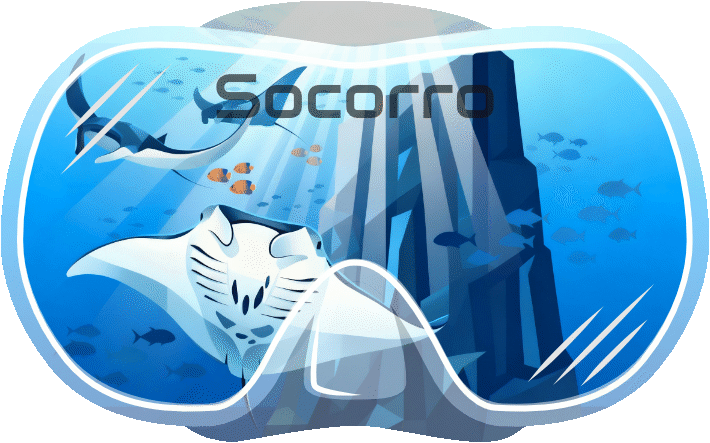
This design captures the signature scene of a Socorro trip: The Boiler. We illustrated the distinct, vertical ridges of this submerged volcanic pinnacle in the background, which acts as a massive cleaning station. In the foreground, we placed a Giant Manta Ray banking toward the viewer, surrounded by bright orange Clarion Angelfish. These endemic fish are famous for cleaning the mantas, and seeing them at work is the hallmark of a dive in this archipelago.
Diving Socorro
Socorro and the surrounding Revillagigedo islands sit roughly 390 kilometres south of Cabo San Lucas, and they are best known for giant oceanic manta rays that actively seek out divers — animals with wingspans over five metres that hover above a group, apparently enjoying the bubbles. Humpback whales pass through in winter and are often heard throughout a dive. Dolphins, hammerheads and silvertip sharks fill in around them. The archipelago is a Mexican national park and UNESCO site, reached only by liveaboard on a 24-hour crossing.
- Best time to dive
- November to May — boats do not run in the summer hurricane season
- Difficulty
- Advanced — blue-water sites with current and surge
- Water temperature
- 21–27°C
- Visibility
- 20–30m
Top dive sites
- •The Boiler, San Benedicto — The classic giant manta site
- •Roca Partida — Tiny pinnacle stacked with sharks
- •Cabo Pearce, Socorro — Ridge with mantas and dolphins
What you’ll see
Frequently asked questions
When is the Socorro diving season?
Liveaboards run roughly from November to May and stop entirely for the summer hurricane season. Within that window, January to March is peak for humpback whales, which are frequently audible underwater and sometimes seen. Water is coolest around February at about 21 to 23°C, warming towards the end of the season. Giant mantas are present across the whole season, which is what most divers come for.
Why are the mantas at Socorro so interactive?
Nobody knows for certain, but the giant oceanic mantas here have a long-documented habit of approaching divers and holding position overhead, apparently attracted to exhaled bubbles. Encounters can last a whole dive. The etiquette matters: do not chase, do not swim above them and never touch — their skin carries a protective mucus layer. Stay still, keep your bubbles going and let the animal decide how close it wants to be.