Cyprus
UK/Europe
Cyprus
£2.50
Cyprus: The Sunken Giant
Cyprus puts the Mediterranean firmly on the global diving map for one massive reason: the Zenobia. This isn't just a boat; it is a behemoth. A 172-meter roll-on/roll-off ferry that went down in 1980 with over 100 fully loaded trucks still chained to the decks. Widely ranked as one of the top ten wreck dives in the world, the sheer scale of the site is mind-boggling. Swimming past lines of suspended lorries in the deep blue creates an eerie, industrial atmosphere that you can't find anywhere else. It is the ultimate playground for rust-lovers and arguably the best wreck dive in Europe.
Why We Chose This Sticker Design
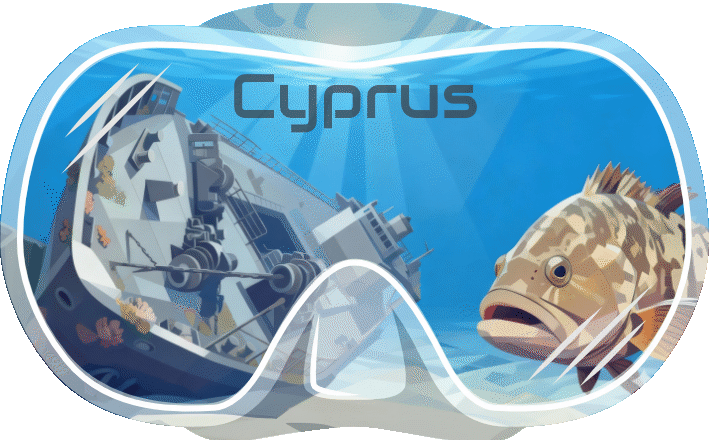
We anchored this artwork completely around the Zenobia’s massive, tilted hull because it is the undisputed king of Cyprus diving. We specifically illustrated the iconic view of the cargo deck, complete with the ghostly silhouette of a sunken truck, to capture the surreal experience of diving a "traffic jam" underwater. To bring some life to the steel, we placed a massive Dusky Grouper in the foreground. These grumpy-looking giants are the wreck's most famous guardians (often named "George"), and no trip to the Zen is complete without a stare-down from one.
Diving Cyprus
Cyprus is, for most visiting divers, one wreck: the Zenobia. A Swedish-built roll-on roll-off ferry, she developed a ballast fault on her maiden voyage and capsized off Larnaca in June 1980, taking around a hundred articulated lorries down with her. She now lies on her port side in 16 to 42 metres of clear, warm Mediterranean water, and she is enormous — nearly 180 metres of ship, with the lorries still chained in rows on her cargo decks. Very few wrecks combine that scale, that clarity and that accessibility, which is why she appears on almost every list of the world's best wreck dives. The rest of Cyprus offers pleasant reef and cavern diving, but the Zenobia is the reason people book flights.
- Best time to dive
- April to November; diveable year-round
- Difficulty
- Intermediate for the outside; technical for deep penetration
- Water temperature
- 16°C in winter to 28°C in late summer
- Visibility
- 20–40m
Top dive sites
- •Zenobia — The main event — 16 to 42m, lorries still aboard
- •Amphorae Caves, Paphos — Shallow caverns with ancient amphorae
- •Green Bay, Protaras — Very shallow, ideal for training and night dives
- •Cyclops cave — Cavern diving along the eastern coast
- •HMS Cricket — Gunboat wreck for more experienced divers
What you’ll see
Frequently asked questions
What certification do I need to dive the Zenobia?
The wreck starts at around 16 metres at the shallowest point of the hull, so an Open Water diver can dive parts of the exterior with a guide. Advanced Open Water opens up much more, since the most impressive sections — the cargo decks with the lorries, and the lower structure — sit between 25 and 42 metres. Any real penetration into the interior is overhead-environment diving and needs wreck training, appropriate gas and a guide who knows the routes. Many divers use nitrox to extend bottom time.
Why is the Zenobia considered one of the world's best wreck dives?
Scale, clarity and cargo. She is nearly 180 metres long, lying on her side in warm water with 20 to 40 metres of visibility, which means you can actually appreciate her size rather than groping along a hull in the gloom. The cargo is what makes her unique: around a hundred articulated lorries still chained to the decks, some with their loads intact, giving the wreck an eerie, frozen-in-1980 quality. She is also close to shore off Larnaca, so access is easy and dives are run daily.
When is the best time to dive Cyprus?
April to November covers the comfortable season, with water climbing from around 18°C in spring to 28°C by late summer and visibility consistently excellent. Diving continues through winter, when the sea drops to about 16°C and you would want a 7mm, but the water is often at its clearest and the sites are empty. Because the Zenobia sits in a sheltered position off Larnaca, trips run in most conditions, making Cyprus one of the more weather-reliable European destinations.