Sardinia
UK/Europe
Italy
£2.50
Sardinia: The Island of Red Gold
Sardinia is often described as the "Caribbean of Europe" thanks to its insane visibility and turquoise water, but its true treasure lies deeper. This Italian island is the historic capital of Corallium rubrum—precious Red Coral. For centuries, this "Red Gold" was harvested for jewelry, but divers know the real privilege is seeing it alive. In marine protected areas like Capo Caccia, the underwater cliffs and massive caverns (like the legendary Nereo Cave) are decorated with these crimson branches. It is a destination where the dramatic granite landscapes above water continue straight down into the abyss.
Why We Chose This Sticker Design
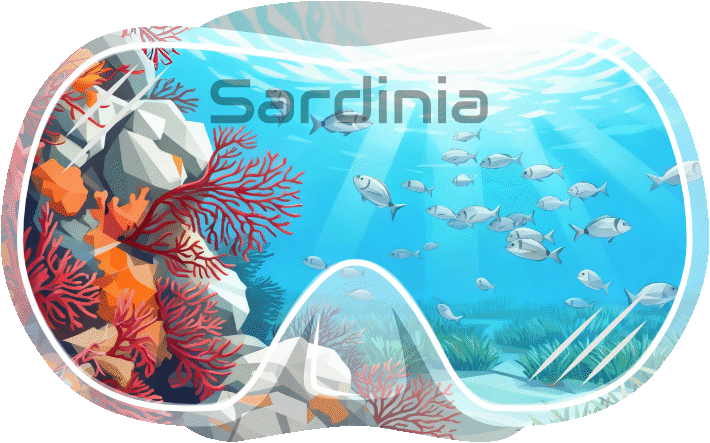
This design highlights the specific organism that put Sardinia on the map. We anchored the left side of the frame with a vibrant colony of Red Coral (Corallium rubrum), capturing its distinct branching structure against the grey limestone rock. To contrast with the static reef, we filled the open blue water with a school of Sea Bream swimming through the light rays, emphasizing the crystal-clear visibility that defines Mediterranean summer diving.
Diving Sardinia
Sardinia's nickname among divers comes from Corallium rubrum — the deep red Mediterranean coral that was harvested from these waters for centuries and traded like a precious metal, giving Alghero its reputation as a coral town. Today the coral is protected and regulated, and the diving that surrounds it is some of the best in the western Mediterranean. Nereo Cave at Capo Caccia is the headline: one of the largest underwater caves in the Mediterranean, a complex of tunnels and chambers big enough to feel genuinely cathedral-like. Elsewhere the island offers marine protected areas at Tavolara and Capo Carbonara where grouper populations have visibly recovered, granite topography, and a scattering of wrecks. The water is clear, the season is long, and it is far less crowded than the Italian mainland.
- Best time to dive
- May to October
- Difficulty
- Intermediate — cave and cavern sites need proper training
- Water temperature
- 14°C in spring to 26°C in late summer
- Visibility
- 20–30m
Top dive sites
- •Nereo Cave, Capo Caccia — Among the largest underwater caves in the Med
- •Tavolara — Marine protected area with big groupers and walls
- •Capo Carbonara — Protected reserve off Villasimius
- •Angelika wreck — Accessible wreck on the north-west coast
- •Secca del Papa — Pinnacle dive with gorgonians and pelagics
What you’ll see
Frequently asked questions
Can you see red coral diving in Sardinia?
Yes, and it is one of the island's signatures — Corallium rubrum grows on shaded overhangs, cave roofs and deeper walls, and Nereo Cave at Capo Caccia is particularly known for it. Bear in mind that it is a slow-growing, heavily regulated species: harvesting is tightly controlled and taking it as a diver is prohibited. The best displays tend to sit below 30 metres or in shaded cavern sections where light is limited, so a torch makes an enormous difference to seeing the colour properly.
Do I need cave training to dive Nereo Cave?
For the classic guided route, generally no — the main passage is large, has natural light at both ends and is dived as a cavern by recreational divers with a local guide who knows it. That said, it is still an overhead environment, and comfort with buoyancy, a torch and staying tight to your guide are essential. The deeper and more complex sections of the system are genuine cave diving and require proper cave training. Book with an Alghero operator that runs the site regularly rather than treating it as a casual dive.
When is the best time to dive Sardinia?
May to October, with June, September and early October offering the best balance — warm water, good visibility and far fewer tourists than the Italian August peak. Surface temperatures reach around 26°C in late summer, though a thermocline below 25 or 30 metres can drop things sharply, so a 5mm with a hood is a sensible minimum for deeper cave and wall dives. Winter diving is possible with the right exposure protection but many operators run reduced schedules.