Norway
UK/Europe
Norway
£2.50
Norway: The Arctic Herring Run
If you think diving is only for the tropics, Norway is here to change your mind—and freeze your face off in the best way possible. This is the ultimate cold-water safari. Every winter, massive shoals of herring migrate into the dark, icy fjords, drawing in the ocean's smartest apex predators. It’s one of the few places on Earth where you can slip into the freezing water (usually on snorkel!) to witness Orcas and Humpbacks feasting in a coordinated frenzy. It is raw, it is wild, and it is a humbling reminder of who really rules the ocean.
Why We Chose This Sticker Design
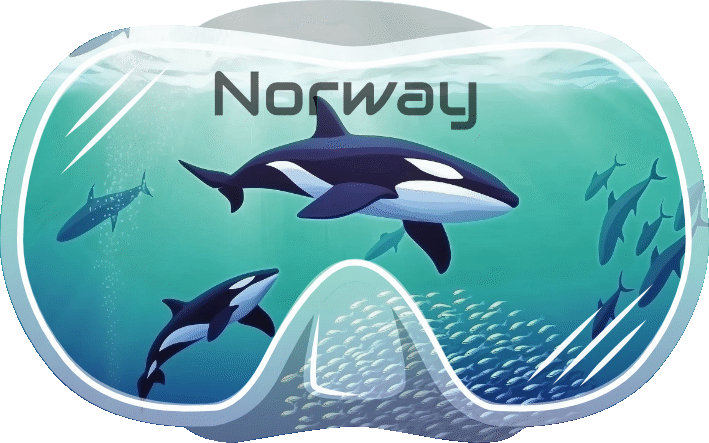
We had to capture the sheer power of the "King of the Fjords" for this piece. The Orca’s crisp black-and-white markings are unmistakable, and we wanted to freeze that heart-stopping moment when they corral a bait ball of herring. We shifted the color palette away from tropical blues to the deep, moody emeralds and glacial teals that define the nutrient-rich Arctic waters. It’s a design for the adventurer who isn't afraid of the cold—or the massive company you keep in it
Diving Norway
Norway offers two completely different underwater experiences depending on when you go. In winter, the herring migration draws orcas and humpback whales into the fjords around Skjervøy and Tromsø, and snorkellers get into the water alongside feeding whales in the blue twilight of the Arctic day — an encounter with very few equals anywhere. In summer, the same coastline offers cold, clear water over kelp forests, wolf-fish and a long list of wrecks, with Gulen near Bergen acting as a hub for technical divers. Saltstraumen near Bodø adds the world's strongest tidal current, dived at slack water when the maelstrom briefly pauses. It is demanding, expensive and, for cold-water divers, close to the top of the list.
- Best time to dive
- November to January for whales; May to September for diving
- Difficulty
- Advanced — cold, remote, and current-affected
- Water temperature
- 4–15°C — drysuit essential year-round
- Visibility
- 10–30m, often excellent in cold months
Top dive sites
- •Skjervøy & Tromsø fjords — Orca and humpback snorkelling in winter
- •Saltstraumen — The world's strongest tidal current — slack water only
- •Gulen — Wreck and technical diving hub near Bergen
- •Lofoten walls — Steep drop-offs with dense soft coral
- •Frankenwald wreck — Large intact wreck for experienced divers
What you’ll see
Frequently asked questions
Can you scuba dive with orcas in Norway?
No — whale encounters in Norway are snorkel-only, and that is both regulation and good practice. Norwegian rules restrict in-water interaction with whales, and operators run these trips as snorkelling from a boat rather than scuba. In practical terms it works better anyway: the whales are feeding near the surface on herring, bubbles from scuba tend to push them away, and a snorkeller can move quickly and quietly into position. Expect short, cold, repeated entries rather than a single long dive.
When is the whale season in northern Norway?
Roughly November through January, tied to the herring that draw the whales into the fjords — most operators run trips from Skjervøy, Tromsø and the surrounding area during that window. Be aware of the light: at that latitude in December there is no true sunrise, and you are working in a few hours of blue polar twilight each day. The herring shift their wintering grounds over the years, so the exact hotspot moves; check where operators are actually running before booking flights.
What is diving Saltstraumen like?
Saltstraumen is the strongest tidal current in the world, with enormous volumes of water forced through a narrow strait four times a day, generating whirlpools visible from the bridge above. You dive it only at slack water, in a window that can be as short as twenty minutes, with a guide who knows exactly when to get in and out. The reward is a reef fed by that constant nutrient flow — dense anemones, huge cod and wolf-fish. It is not a site for divers new to cold water or current.