Scapa Flow
UK/Europe
Scotland
£2.50
Scapa Flow: The Wreck Diver’s Holy Grail
Scapa Flow is where history goes to rest, and where wreck divers go to find nirvana. Tucked away in the chilly waters of Scotland’s Orkney Islands, this isn't your typical tropical holiday—it's a cold-water pilgrimage. This legendary natural harbor is the underwater graveyard of the German High Seas Fleet, scuttled in 1919. It offers a hauntingly beautiful playground of massive battleships and cruisers that dwarf divers and demand respect. It’s moody, it’s metallic, and it is absolutely essential diving for anyone who loves "rust."
Why We Chose This Sticker Design
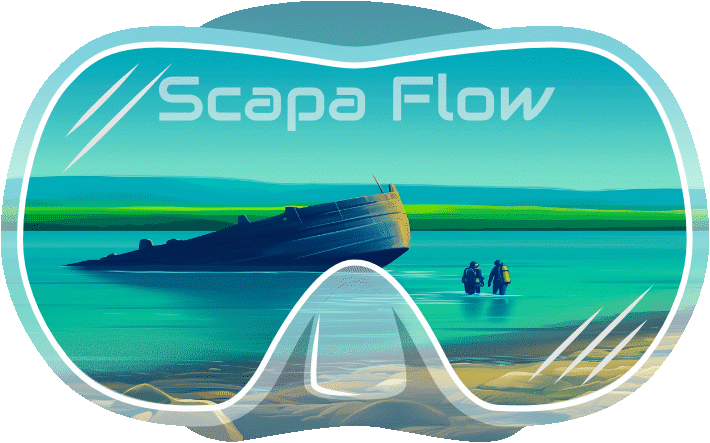
We wanted to capture the unique atmosphere of the North Atlantic for this piece. Instead of showing the deep gloom, we focused on the anticipation of the entry—wading into those distinct teal-green waters with the silhouette of a blockship looming on the horizon. The muted color palette of slate greys, cyans, and cold greens perfectly mimics the stark, rugged beauty of the Scottish landscape. It’s a design that honors the drysuit diver and the quiet, heavy sense of history that hangs over the Flow.
Diving Scapa Flow
Scapa Flow in Orkney is a pilgrimage. On 21 June 1919, believing the armistice talks had collapsed, Rear Admiral von Reuter ordered the interned German High Seas Fleet scuttled where it lay — 74 warships opened their seacocks in a single afternoon. Most were salvaged in the decades that followed, but seven major vessels remain: three König-class battleships and four light cruisers, lying in 12 to 45 metres of cold, dark Orkney water. Diving them is like moving along the flank of a building — the battleships are so large that a single dive shows you a fraction of one. Add the shallow blockships in Burra Sound for a drift among sunlit wreckage, and it is arguably the finest wreck diving in Europe.
- Best time to dive
- May to September
- Difficulty
- Advanced — depth, cold and low light; nitrox is standard
- Water temperature
- 6–14°C — drysuit essential
- Visibility
- 5–15m, and darker the deeper you go
Top dive sites
- •SMS Karlsruhe — The shallowest cruiser — the usual first wreck
- •SMS Dresden & SMS Cöln — Light cruisers lying on their sides
- •SMS Markgraf — Battleship at 45m — the deepest and most atmospheric
- •SMS Kronprinz Wilhelm — Battleship with huge exposed armour belt
- •Burra Sound blockships — Shallow, bright drift dives over broken wreckage
What you’ll see
Frequently asked questions
What experience do I need to dive Scapa Flow?
More than a typical UK reef trip. The cruisers sit around 25 to 35 metres and the battleships closer to 45, in cold water with limited natural light, so operators generally expect a solid drysuit diver with Advanced Open Water as a minimum and often ask for deep and nitrox qualifications. Nitrox is effectively standard here because it buys meaningful bottom time at those depths. Many divers do the battleships as staged decompression dives. If you are newly qualified, the blockships in Burra Sound are shallow and spectacular in their own right.
Which wrecks are left in Scapa Flow?
Seven major German warships from the 1919 scuttling remain: the battleships SMS König, SMS Kronprinz Wilhelm and SMS Markgraf, and the light cruisers SMS Karlsruhe, SMS Dresden, SMS Brummer and SMS Cöln. Most of the other 45 or so ships that sank were commercially salvaged between the wars. Alongside them lie the blockships deliberately sunk to seal the eastern approaches. HMS Royal Oak, torpedoed in 1939 with the loss of 835 lives, is a designated war grave and diving on her is prohibited.
When is the best time to dive Scapa Flow?
May to September, and within that many divers favour May and June for the longest daylight — at that latitude the summer evenings barely get dark, which matters when you are diving wrecks that swallow light. Water hovers between 6 and 14°C across the season. Orkney weather is the real variable: trips are usually liveaboard or shore-based out of Stromness, and a windy week can restrict which side of the Flow is diveable. Book well ahead, as the good boats fill a year out.