St Abbs
UK/Europe
Scotland
£2.50
St Abbs: Scotland’s Living Reef
St Abbs is absolute proof that you don't need tropical heat to find a coral reef. As one of the UK’s most beloved Voluntary Marine Reserves, this spot is a biological explosion located on the Berwickshire coast. It is famous for its dramatic underwater topography, where massive rock "cathedrals" and gullies are carpeted in life. It completely challenges the idea that cold water is drab; here, the rocks are literally fuzzy with soft corals and crustaceans, offering a kaleidoscope of texture and color that rivals any tropical destination. It is a cold-water garden in every sense of the word.
Why We Chose This Sticker Design
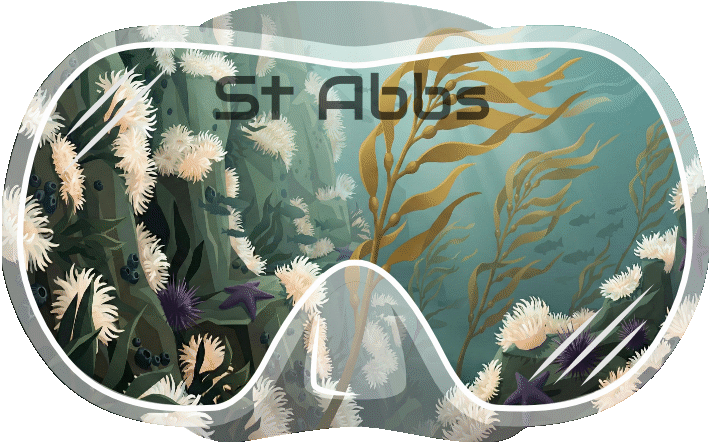
We wanted to capture the incredible texture that makes St Abbs so unique. The star of this design is the dense coverage of white Plumose Anemones, which we illustrated coating the rocky walls on the left side to show just how prolific the life is here. To balance that "fluffy" rock texture, we added the tall, swaying fronds of the Kelp forest on the right, capturing the constant motion of the shallow surge. The color palette relies on earthy ochres, creamy whites, and cold-water teals to perfectly mimic the mood of the North Sea.
Diving St Abbs
St Abbs, on the Berwickshire coast, is where people who claim UK diving is murky get proved wrong. The voluntary marine reserve established here in 1984 protects a stretch of coastline where cold, clean North Sea water regularly delivers ten to twenty metres of visibility over rock architecture that genuinely deserves the word dramatic. Cathedral Rock is the signature — a natural double arch swimmable at around 15 metres, walls covered in dead man's fingers. The reserve's protection shows in the fish: big ballan wrasse that do not flee, and the wolf-fish that St Abbs is quietly famous for, sitting in crevices looking thoroughly unimpressed. Shore diving from the harbour is easy and boats run from Eyemouth.
- Best time to dive
- May to September
- Difficulty
- Easy to intermediate — good shore access, some swell exposure
- Water temperature
- 7–14°C — drysuit
- Visibility
- 10–20m, excellent by UK standards
Top dive sites
- •Cathedral Rock — The famous twin natural arch — the classic dive
- •Anemone Gullies — Shallow rock gullies packed with anemones
- •Big Green Carr — Boat site with walls and reliable wrasse
- •Glanmire — Broken steamer wreck at around 30m
- •St Abbs harbour — Sheltered shore entry, ideal for a check dive
What you’ll see
Frequently asked questions
Why is visibility so good at St Abbs?
A combination of cold, clean North Sea water, a rocky rather than silty seabed, and relatively little freshwater runoff along this stretch of coast. There is nothing to put into suspension, so once any swell has settled the water clears quickly and ten to twenty metres is normal — occasionally more. The trade-off is exposure: this coastline takes weather straight off the North Sea, so a strong northerly or easterly will shut sites down and stir things up for a day or two afterwards.
Can you shore dive at St Abbs?
Yes, and it is one of the main attractions. Entries from St Abbs harbour and the nearby coves give straightforward access to sheltered gullies rich in anemones and wrasse, making it a favourite for club weekends and skills practice. Boat trips out of Eyemouth open up the bigger sites like Cathedral Rock and the offshore reefs. Check current guidance on harbour access and parking before travelling, as arrangements for divers have changed over the years.
What is the best time of year to dive St Abbs?
May to September, with midsummer offering long daylight and the calmest conditions. Visibility typically improves as the spring plankton bloom clears through late May and June. Water temperature runs from around 7°C early in the season to a peak of about 14°C in late August, so this is drysuit diving whenever you visit. Because the site is so weather-dependent, flexible dates beat fixed ones — keep an eye on wind direction rather than the calendar.