Plymouth
UK/Europe
England
£2.50
Plymouth: The City of Wrecks
Plymouth is often called the diving capital of the UK, and for good reason. Its coastline is a graveyard of maritime history, littered with wrecks that range from World War II liberty ships like the James Eagan Layne to submarines and artificial reefs like the HMS Scylla. It is a destination that demands respect; the water is green, the currents can be tricky, and the history is palpable. Diving here feels like swimming through a museum where every twisted piece of metal has a story to tell, now reclaimed by nature as a thriving artificial reef.
Why We Chose This Sticker Design
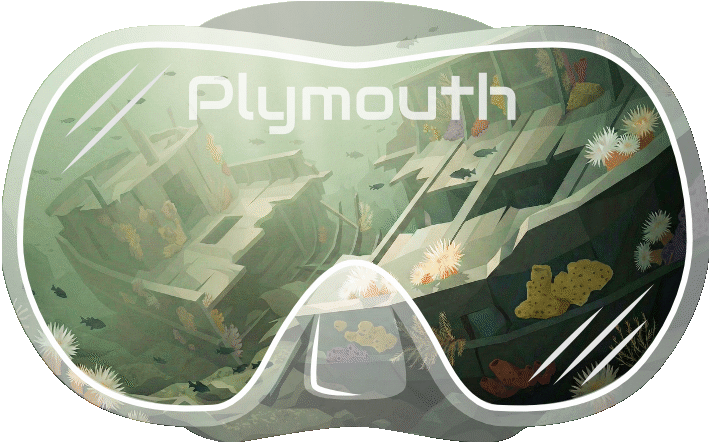
To capture the eerie beauty of Plymouth's underwater heritage, we focused on the structure of a shipwreck. The design features the skeletal remains of a large vessel resting on the seabed, its hull broken open to reveal the dark interior. We didn't want it to look dead, though, so we covered the wreckage in colonies of white and orange plumose anemones—the signature life form of British wrecks. The muted green water tone perfectly replicates the visibility and atmosphere of a classic English Channel dive.
Diving Plymouth
Plymouth is the practical heart of UK diving — a working city with a huge natural harbour, a dive shop on most corners, and more wrecks within an hour's boat ride than most divers get through in years. Plymouth Sound became the UK's first National Marine Park in 2019. The two signature dives are the James Eagan Layne, an American Liberty ship torpedoed in 1945 and now sitting broken and swimmable in Whitsand Bay, and HMS Scylla, a Royal Navy frigate deliberately scuttled in 2004 to create an artificial reef and now thoroughly colonised. Add straightforward shore dives at Bovisand for training and skills, and it becomes obvious why so many British divers learn here.
- Best time to dive
- May to October
- Difficulty
- Beginner to intermediate — sheltered shore sites plus boat wrecks
- Water temperature
- 8–17°C — drysuit for most of the year
- Visibility
- 3–12m, very dependent on wind and tide
Top dive sites
- •James Eagan Layne — WWII Liberty ship, broken open and easy to swim
- •HMS Scylla — Frigate scuttled in 2004 as an artificial reef
- •Bovisand — Sheltered shore dive, the classic training site
- •Glen Strathallan — Shallow wreck inside the breakwater
- •Hand Deeps — Offshore pinnacle for experienced divers
What you’ll see
Frequently asked questions
What are the best wreck dives in Plymouth?
The James Eagan Layne is the classic — a US Liberty ship torpedoed in 1945 and beached in Whitsand Bay, now lying at around 22 to 25 metres. Decades of collapse have opened her up, so she is unusually easy and well-lit to swim through compared with an intact hull. HMS Scylla, a Leander-class frigate scuttled nearby in 2004 as an artificial reef, is the other must-dive and is now completely covered in growth. Both sit at recreational depths and are run regularly by hard boats out of Plymouth.
Is Plymouth good for new divers?
It is one of the best places in the UK to build experience. Sheltered shore sites like Bovisand give you easy entries, shallow depths and enough to look at for skills practice and night dives, and the city has a dense concentration of clubs, schools and hard boats competing for business. The main wrecks sit within Advanced Open Water depths. The genuine challenge is not depth but conditions: cold water, a drysuit and reduced visibility all demand more task loading than a warm-water holiday dive.
How is visibility in Plymouth Sound?
Honestly, variable — anywhere from three metres after a blow to a very respectable twelve on a good day. Wind direction and tide state matter more than season: a settled spell with an offshore breeze on a neap tide transforms the place. The spring plankton bloom knocks visibility down through April and May before things clear again. Offshore sites like Hand Deeps generally offer better water than sites inside the Sound, which take runoff from the rivers after heavy rain.