Gozo
UK/Europe
Malta
£2.50
Gozo: The Blue Portal
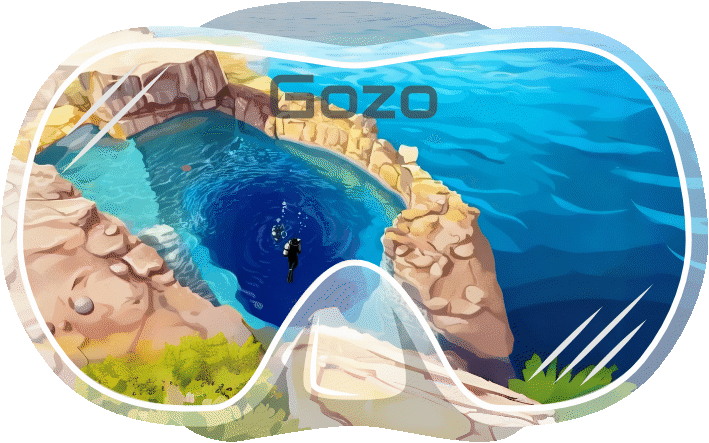
Gozo is the wilder, rugged sister of Malta. While the main island is famous for history, Gozo is famous for geology. The undisputed king of Gozitan diving is the "Blue Hole" at Dwejra. It is one of the most unique shore dives in the world: you start by walking over fossilized limestone to jump into a natural, protected rock pool. From there, you descend through a vertical chimney that opens up into the deep blue ocean through a massive underwater archway. It is a geological playground where the light effects are nothing short of spiritual.
Why We Chose This Sticker Design
This design captures the iconic entry point of the Mediterranean's most famous shore dive. We illustrated the Blue Hole from a high angle to show how this natural limestone pool is carved directly into the coast. The design emphasizes the stark contrast between the beige, sun-baked rocks and the deep sapphire water of the hole itself. We included a diver beginning their descent, representing the moment you slip from the surface world into the cavern below.
Diving Gozo
Gozo is Malta's quieter sister island, and for many divers it is the better half. The diving is defined by limestone — vertical walls, tunnels, caverns and the famous Blue Hole at Dwejra, a natural rock pool that connects to the open sea through an arch at around eight metres. Swimming out of that arch into blue water dropping away beneath you is one of the Mediterranean's genuinely great dive moments. Nearby, the collapsed remains of the Azure Window, which fell into the sea in a storm in March 2017, now form a boulder field that has become a dive site in its own right. Visibility is regularly thirty metres or more, and almost everything is a shore dive reached down a track and a set of steps.
- Best time to dive
- May to October, diveable year-round
- Difficulty
- Intermediate — shore entries can be awkward; some sites advanced
- Water temperature
- 15°C in winter to 27°C in late summer
- Visibility
- 25–40m
Top dive sites
- •Blue Hole & the Arch — Gozo's signature dive at Dwejra
- •Azure Window remains — The collapsed arch, now a boulder field
- •The Chimney — Vertical crack you ascend through in the rock
- •Inland Sea tunnel — An 80m tunnel opening onto a sheer wall
- •Xlendi Cave — Shallow cavern, good for less experienced divers
What you’ll see
Frequently asked questions
Is the Blue Hole in Gozo difficult to dive?
The diving itself is straightforward, but the logistics are not. The Blue Hole sits at the bottom of a rough limestone shore at Dwejra, and you carry your kit down uneven rock to reach it — the walk out afterwards is what people remember. Once in, you drop into a natural pool and swim out through an arch at around eight metres onto a wall dropping well past recreational limits. Swell can make the entry genuinely hazardous, so operators call it off when conditions are wrong. Depth discipline matters, as the wall invites you deeper.
Can you still dive the Azure Window?
Not as it was — the arch collapsed into the sea during a storm in March 2017. What remains is arguably still worth diving: enormous limestone blocks scattered across the seabed forming a dramatic boulder field and swim-throughs, at depths that suit recreational divers. It is combined with the Blue Hole on most Dwejra dives. If you saw photographs of the Window before it fell and expected to swim beneath it, adjust expectations, but do not skip the site.
Should I dive Gozo or Malta?
Ideally both, since the ferry between them takes about 25 minutes. Malta has the better wrecks — Um El Faroud, P29 and Rozi — plus more infrastructure and easier shore access. Gozo has the more dramatic topography: walls, tunnels, caverns and the Blue Hole, with fewer divers on the sites and generally slightly better visibility. Divers who prioritise wrecks base themselves on Malta; those who prefer rock architecture and a quieter trip stay on Gozo.