Iceland
UK/Europe
Iceland
£2.50
Iceland: Diving Between Two Worlds
Iceland offers a dive site that sounds like pure science fiction: Silfra. This is the only place on Earth where you can strap on a drysuit and literally swim between two continental plates. You are drifting in the crack where North America and Eurasia are slowly tearing apart. But the real headline here is the visibility. Because the water is glacier melt that has been filtered through porous lava rock for decades, it is as clear as gin. We’re talking 100+ meters of visibility. It feels less like diving and more like flying through liquid glass in a geological cathedral.
Why We Chose This Sticker Design
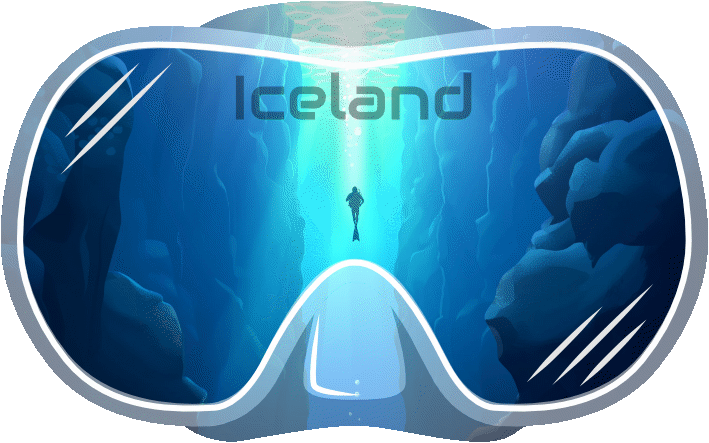
For the Silfra sticker, we knew we had to capture the sheer scale of the fissure. We chose a vertical composition with towering, dark rock walls to dwarf the diver, emphasizing just how small you feel inside that tectonic crack. The color palette is strictly monochromatic—using deep indigos, electric cyans, and glacial blues—to perfectly mimic that freezing, crystal-clear water. It’s a moody, atmospheric design for the diver who prefers geology over fish and doesn't mind a little brain freeze for the view.
Diving Iceland
Silfra is the reason divers come to Iceland, and it is unlike anywhere else on earth. The fissure sits inside Þingvellir National Park, in the rift valley where the North American and Eurasian plates are pulling apart, and it is filled with glacial meltwater from Langjökull that has spent decades filtering through porous lava rock. The result is water so pure that visibility is routinely quoted at over a hundred metres — you can see the far end of a flooded canyon as clearly as you would in air. It is also 2 to 4°C, every day of the year, which is why every operator requires drysuit certification and logged dry dives. Iceland's other secret is Strýtan in the north, a geothermal chimney venting hot water on a site found almost nowhere else in the world.
- Best time to dive
- Year-round — the water temperature never changes
- Difficulty
- Intermediate — drysuit certification is mandatory, not optional
- Water temperature
- 2–4°C all year
- Visibility
- Over 100m at Silfra, the clearest in the world
Top dive sites
- •Silfra Big Crack — The narrow section between the rift walls
- •Silfra Cathedral — Long, deep canyon with staggering visibility
- •Silfra Lagoon — Shallow finish over bright blue-green algae
- •Strýtan — Geothermal chimney rising from the seabed, north Iceland
- •Bjarnagjá — Quieter lava fissure on the Reykjanes peninsula
What you’ll see
Frequently asked questions
Do I need drysuit certification to dive Silfra?
Yes, and operators enforce it strictly. Because the water sits at 2 to 4°C year-round, every Silfra dive operator requires a recognised drysuit specialty certification plus a minimum number of logged drysuit dives — commonly ten — within a recent period, and they will ask to see your logbook. Divers who turn up without it are turned away or offered snorkelling instead. If you want to dive Silfra, complete your drysuit training at home before you travel; you cannot do it on the day.
How cold is Silfra really, and can I handle it?
It is 2 to 4°C, which is cold enough that your exposed lips and cheeks go numb within minutes even in a properly fitted drysuit with thick undersuit, hood and dry gloves. Dives are deliberately short, typically around 30 to 40 minutes, and operators run two shorter dives rather than one long one. Most reasonably experienced drysuit divers cope fine — the shock is manageable and the visibility is so extraordinary that people forget the cold. If you dive dry regularly in the UK or northern Europe, you are well prepared.
Can you really touch two tectonic plates at Silfra?
This is the marketing line, and it needs a small caveat. Silfra is a fissure within the rift valley where the North American and Eurasian plates are separating, and in the narrowest section you can touch rock on both sides at once — which is where the photograph comes from. Strictly speaking the plate boundary is a wide zone rather than a single crack, so you are touching two walls of the same rift rather than the plates themselves. It remains a genuinely extraordinary place to dive; just enjoy it for the geology and the water.