Apo Island
South East Asia
Philippines
£2.50
Apo Island: The Little Sanctuary That Could
Apo Island isn't just a dive site; it is arguably the world’s greatest success story for community-led marine conservation. Located off the coast of Negros Oriental in the Philippines, this tiny volcanic island is proof that when you protect the ocean, it bounces back in a big way. The hard coral gardens here are absolutely exploding with life, covering the volcanic rock in a technicolor carpet that rivals any reef on the planet. It’s a high-energy, feel-good destination where you are almost guaranteed to swim alongside massive Green Turtles and witness a reef ecosystem operating at 100% capacity.
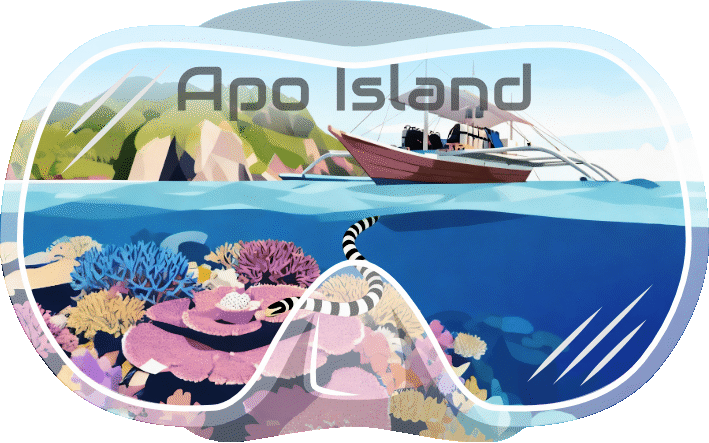
Why We Chose This Sticker Design
We went with a split-shot for Apo because the journey is half the fun! We featured the classic Filipino Bangka boat on the surface—those iconic outrigger boats are the heartbeat of diving in the Philippines, and no trip is complete without a ride on one. Below the surface, we skipped the usual turtle (though they are everywhere!) to highlight another famous resident: the Banded Sea Krait. We loved the visual contrast of its hypnotic black-and-white stripes winding through the vibrant pink and purple table corals. It’s a design that captures the vivid, thriving pulse of this protected paradise.
Diving Apo Island
Apo Island, off the south-east coast of Negros, is one of the most cited conservation success stories in the diving world. In the 1980s local fishermen, working with marine scientists from Silliman University, established a community-managed no-take sanctuary on part of the reef — at a time when the idea was largely untested. Decades on, fish biomass recovered so dramatically that the island became a template studied and copied across the tropics. For divers, that history translates into dense hard coral gardens, sea turtles in numbers that make sightings a certainty rather than a hope, and healthy reef fish populations. The diving is mostly straightforward, though Coconut Point on the exposed side generates serious current and is treated as an advanced site. Most people visit as a day trip from Dauin or Dumaguete.
- Best time to dive
- November to May for the calmest seas
- Difficulty
- Easy to intermediate; Coconut Point is advanced
- Water temperature
- 27–29°C
- Visibility
- 15–30m
Top dive sites
- •Rock Point East — Hard coral garden with constant turtle traffic
- •Coconut Point — Advanced — powerful current and big fish
- •Chapel — Gentle sloping reef, good for all levels
- •Mamsa Point — Jack schools when the current runs
- •The sanctuary — The original protected zone — snorkellable
What you’ll see
Frequently asked questions
Why is Apo Island famous among divers?
Because it demonstrated that community-managed marine protection works. Beginning in the 1980s, local fishermen and marine scientists established a no-take sanctuary covering part of the reef, accepting short-term loss for long-term recovery. Fish populations rebounded strongly enough that the surrounding fishery improved too, and the island became one of the most studied and copied examples of community-based conservation in the tropics. Divers get the visible result: dense coral, abundant turtles and reef fish populations that feel like a different era of diving.
How do I get to Apo Island to dive?
Almost everyone visits as a day trip by banca boat from Dauin or Dumaguete on Negros, a crossing of roughly 30 to 45 minutes depending on conditions. Dive operators along the Dauin coast run trips most days in season, typically offering two or three dives. There is limited simple accommodation on the island itself for those who want an early start or a longer stay. Entry and marine sanctuary fees apply and go towards the protection scheme that made the reef what it is.
Is Apo Island suitable for all diver levels?
Mostly yes, with one clear exception. Sites like Chapel and Rock Point are gentle sloping reefs with mild current, perfect for newer divers, and the shallow sanctuary is excellent even for snorkellers. Coconut Point is different: it sits on the exposed side of the island where currents converge and can run hard, sometimes with downward pull, and it is treated as an advanced dive by every reputable operator. Conditions vary strongly with tide, so let your guide choose the site order on the day.