Coron
South East Asia
Philippines
£2.50
Coron: The Ghost Fleet of Palawan
Coron is where history gets wet. In September 1944, a massive US Navy air raid sent a Japanese supply fleet to the bottom of Coron Bay, creating what is now the undisputed wreck diving capital of Asia. This isn't just about looking at metal; it is about exploring a submerged moment in time. These massive vessels—some over 160 meters long—are hauntingly intact, allowing certified divers to penetrate deep into engine rooms and cargo holds. It is a surreal mix of eerie wartime history and thriving marine life, where cathedrals of rusting steel have become vertical reefs for the ocean to reclaim.
Why We Chose This Sticker Design
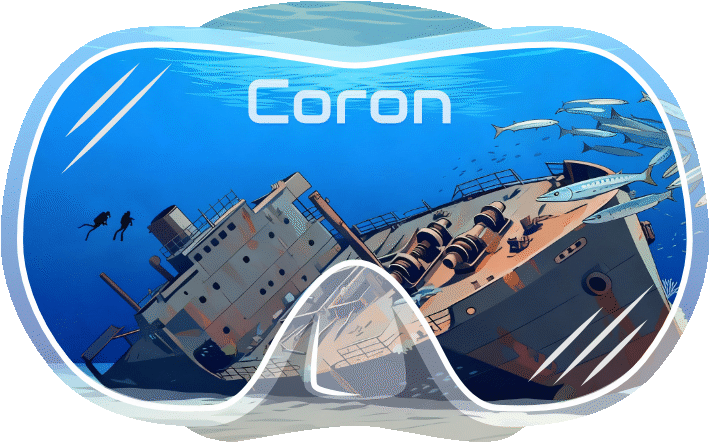
To capture the massive scale of these sunken giants, we centered the composition on the looming, tilted bow of a Japanese freighter. We emphasized the texture of the rusting hull to contrast with the deep blue, creating that moody, atmospheric vibe that defines wreck diving. Of course, no Coron dive is complete without the locals, so we illustrated a school of Barracuda patrolling the deck. These predatory fish are the famous "sentinels" of the wrecks, often hovering motionless in the current as if guarding the ghost fleet.
Diving Coron
Coron Bay in northern Palawan holds one of the most accessible WWII wreck fleets in the world. On 24 September 1944, US carrier aircraft caught a Japanese supply fleet sheltering here, and around a dozen ships went to the bottom in a single day. Eighty years on they sit in 10 to 40 metres of sheltered, warm water — cargo holds, engine rooms and decks colonised by coral and schooling fish. Because they are shallow by wreck-diving standards, recreational divers can enjoy them without technical training, though anything beyond light penetration properly requires a wreck course. Coron's other oddity is Barracuda Lake, a landlocked crater where you swim through a sharp thermocline into water that can exceed 38°C — a strange, memorable dive found almost nowhere else.
- Best time to dive
- November to May, outside the typhoon and monsoon months
- Difficulty
- Intermediate; penetration requires wreck training
- Water temperature
- 28–30°C (and up to 38°C+ in Barracuda Lake)
- Visibility
- 10–25m, silt-dependent inside the wrecks
Top dive sites
- •Irako — The best-preserved wreck — deeper, around 30–40m
- •Okikawa Maru — Large tanker with swim-throughs at moderate depth
- •Akitsushima — Seaplane tender with its crane still visible
- •Olympia Maru — Shallow, coral-covered, ideal first wreck
- •Barracuda Lake — Extreme thermocline in a crater lake
What you’ll see
Frequently asked questions
Do I need wreck certification to dive Coron?
Not to dive the wrecks, but yes for anything more than a glance inside. Most of the fleet sits between 10 and 40 metres, so the shallower wrecks like Olympia Maru can be enjoyed from the outside by any certified diver, and Advanced Open Water covers the deeper ones. Real penetration — moving through cargo holds and engine rooms away from natural light — is overhead-environment diving and needs proper wreck training, a torch and a guide who knows the route. Silt inside the hulls goes up fast and visibility can drop to nothing.
When is the best time to dive Coron?
November to May offers the most settled conditions, with the driest weather and calmest seas across Palawan. The June to October period brings the south-west monsoon and the Philippine typhoon season, meaning more cancelled boats and reduced visibility, though the bay is relatively sheltered. Water stays at 28–30°C year-round, so this is purely about surface conditions. March to May typically delivers the clearest water for photographing the wrecks.
What is Barracuda Lake and why is it so warm?
Barracuda Lake is a landlocked crater lake reached by a short climb over limestone karst, and it is one of the strangest dives in Asia. The water is layered: cool fresh water on top, then a sharply defined thermocline where the temperature jumps dramatically — commonly reported above 38°C — before cooling again deeper. The heat comes from geothermal activity beneath the lake. Visually the thermocline shimmers like heat haze underwater, and the sheer limestone walls make it feel more like flying through a canyon than diving. There is very little marine life; you go for the sensation.