Bunaken
South East Asia
Indonesia
£2.50
Bunaken: The Wall Diving Capital
Bunaken is where you go to feel small. Located in North Sulawesi, this National Marine Park is world-famous for one thing: endless vertical walls. We are talking about reefs that start at the surface and drop thousands of meters straight down into the abyss. It is like flying underwater alongside a living skyscraper. But the real claim to fame here is the turtles. The population of Green and Hawksbill turtles is so dense that divers often stop counting after the first dozen. It is a high-voltage mix of deep blue water, massive drop-offs, and a literal turtle traffic jam.
Why We Chose This Sticker Design
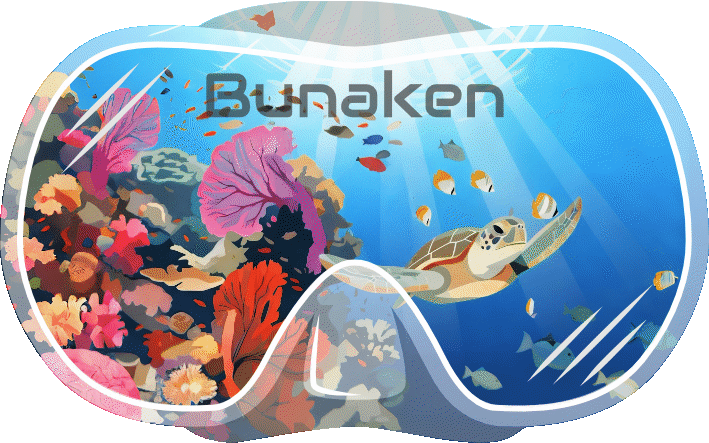
For the Bunaken sticker, the composition had to emphasize the vertical drop. We packed the left side of the frame with a riot of pink, orange, and purple soft corals and fans to capture the sheer density of life that covers these walls. You simply can't represent this park without its mascot, so we featured a chill Sea Turtle cruising through the blue, surrounded by schooling Pyramid Butterflyfish to add that classic reef depth. It’s a design that celebrates the dizzying feeling of drifting along a bottomless edge.
Diving Bunaken
Bunaken National Marine Park, off Manado in North Sulawesi, is built on some of the most dramatic walls in Indonesia — sheer coral cliffs that drop from a shallow reef crest into water hundreds of metres deep. Protected since 1991, the park has mature, intact coral, enormous barrel sponges and gorgonian fans, and a turtle population so relaxed that green turtles will sit on a ledge and ignore you completely. The diving itself is straightforward: you drift along a wall with the reef on one shoulder and open blue on the other, watching turtles and reef fish come and go. Because it sits about an hour from the Lembeh Strait, most divers visiting North Sulawesi split their trip between the two, getting spectacular wall scenery here and world-class muck diving there.
- Best time to dive
- March to October; January and February are the wettest
- Difficulty
- Easy to intermediate — gentle walls, occasional current
- Water temperature
- 27–29°C
- Visibility
- 20–30m and often more
Top dive sites
- •Lekuan I, II & III — The classic Bunaken walls, turtles guaranteed
- •Mandolin — Schooling fish along a steep drop-off
- •Sachiko's Point — Healthy coral and reliable current for a drift
- •Fukui — Gentler slope with giant clams
- •Siladen — Neighbouring island with pretty shallow coral
What you’ll see
Frequently asked questions
When is the best time to dive Bunaken?
March to October is the strongest window, with the driest weather and the best visibility, and many divers pick the middle of that range for the calmest seas. January and February bring the heaviest rain, which can reduce visibility and make crossings less comfortable, though the park still dives. Water temperature is stable at 27–29°C throughout the year. Because Bunaken pairs so naturally with the Lembeh Strait, most people plan around a combined trip rather than around Bunaken conditions alone.
Is Bunaken good for beginners?
Yes, with one caveat. The diving is largely gentle drifting along walls with excellent visibility, no decompression demands and abundant turtles, which makes it very rewarding for newer divers. The caveat is the walls themselves: with the reef dropping into hundreds of metres of water, it is easy to sink deeper than intended without a visual reference. Good buoyancy control and a close eye on your depth are essential. Operators are used to newer divers and generally choose sheltered sites when current is running.
Should I combine Bunaken with Lembeh?
Most divers do, and it is the single best reason to visit North Sulawesi. The two sit roughly an hour or two apart by road across the peninsula from Manado, and they offer opposite experiences: Bunaken is dramatic wall diving with turtles and clear water, Lembeh is shallow black-sand muck diving for rare critters. A week split between them gives far more variety than either alone, and most resorts and operators in the region will arrange the transfer and a combined package as standard.