Banda Sea
South East Asia
Indonesia
£2.50
Banda Sea: The Ring of Fire
The Banda Sea is the ultimate frontier for the adventurous diver. Located in the deep heart of Indonesia, this region is famous for its "Ring of Fire"—a chain of volcanic islands that drop into the abyss. But let’s be real, you come here for one specific season: Hammerhead Season. Twice a year, when the water temps drop, these deep waters attract massive schools of Scalloped Hammerheads. We aren't talking about seeing one or two; we are talking about walls of hundreds swimming in formation against the deep blue. It is a remote, high-energy destination that proves the best diving often requires going off the grid.
Why We Chose This Sticker Design
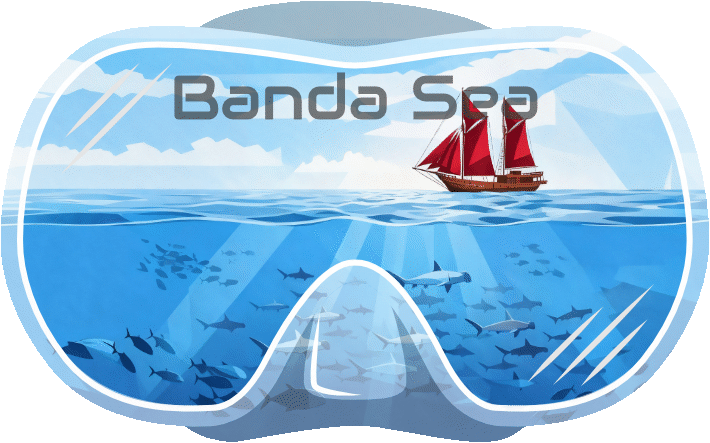
You literally cannot dive the Banda Sea without a home-at-sea, so the traditional Phinisi schooner had to be the star of the surface view. We painted those iconic red sails to capture the romance of sailing through the Indonesian archipelago. For the underwater section, we focused on depth. We used a gradient of deep, rich blues to represent the bottomless drop-offs of the volcanic walls, contrasting the calm silence of the boat above with the wild, prehistoric action of the schooling hammerheads below. It’s the perfect snapshot of life on a liveaboard.
Diving Banda Sea
The Banda Sea, in eastern Indonesia, is a liveaboard-only crossing dived during two short windows each year when the seas allow. It is remote, deep-ocean diving around volcanic islands with steep walls and startlingly clear water. Two things define it: hammerhead sharks, which school here in the autumn window, and the sea snakes of Gunung Api, where thousands of banded sea kraits swarm over the reef in numbers that unsettle most divers on first sight. The Banda Islands themselves were the world's only source of nutmeg, and the history ashore is as remarkable as the diving.
- Best time to dive
- Two crossing windows — roughly March to April and September to November
- Difficulty
- Advanced — remote, deep walls and current
- Water temperature
- 26–29°C
- Visibility
- 20–40m
Top dive sites
- •Gunung Api — Sea krait aggregation over volcanic slopes
- •Manuk — Remote volcanic island, sea snakes and pelagics
- •Banda Neira — Walls and lava flows beneath the old spice port
- •Koon — Big-fish site often included on the crossing
What you’ll see
Frequently asked questions
When can you dive the Banda Sea?
The Banda Sea is dived on liveaboard crossings that run in two short windows, broadly March to April and September to November, when conditions between Indonesia’s monsoons allow the passage. The autumn window is the one associated with schooling hammerheads. Because these are repositioning crossings between other regions, the itineraries are limited and sell out early — this is not a destination you can book at short notice.
Are the sea snakes at Gunung Api dangerous?
Banded sea kraits are highly venomous but extremely placid towards divers, and there is no history of incidents on these dives despite the numbers involved — they are often described as more curious than threatening, sometimes investigating a diver’s mask or arm. They need to surface to breathe, so they move constantly past you. The advice is simply to stay calm, keep your hands still and let them pass rather than pushing them away.