Lembeh
South East Asia
Indonesia
£2.50
Lembeh: The Capital of Weird
Lembeh Strait is widely considered the "Muck Diving Capital of the World," and for good reason. It is basically the twilight zone of the ocean. Located in North Sulawesi, this channel consists of black volcanic sand slopes that, at first glance, look like an underwater wasteland. But look closer, and you will find the highest density of bizarre critters on the planet. From Hairy Frogfish to Bobbit Worms, this is where you go to see evolution’s strangest experiments. It isn't about the coral here; it is about the "treasure hunt" for the cryptic, the camouflaged, and the downright alien.
Why We Chose This Sticker Design
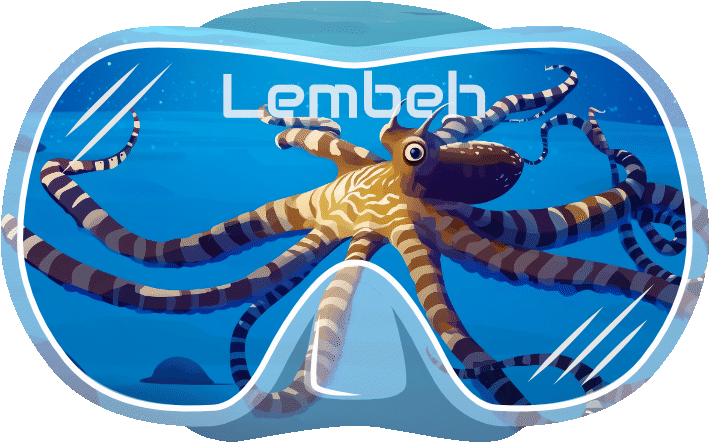
For this design, we knew the spotlight had to be on the shapeshifting king of the strait: the Mimic Octopus. This intelligent cephalopod is famous for impersonating lionfish, flatfish, and sea snakes to avoid predators. We illustrated it with its arms splayed wide to showcase its iconic black-and-white banding, a pattern that is instantly recognizable to any muck diver. The composition captures that moment of discovery when the animal "blows its cover" against the sandy bottom, staring right back at you with those distinct, horned eyes.
Diving Lembeh
The Lembeh Strait in North Sulawesi is the muck diving capital of the world, and it is a place that divides divers instantly. There is very little coral, the bottom is black volcanic sand, and the visibility is often unremarkable. What there is instead is the strangest concentration of animals on earth: hairy frogfish, mimic octopus, wonderpus, blue-ringed octopus, flamboyant cuttlefish, rhinopias, bobbit worms. Dives are shallow, current is usually minimal, and you spend the whole time hovering a metre off the sand while a guide points out something the size of your thumbnail that turns out to be extraordinary. It is heaven for underwater photographers and, for divers who need reef scenery and big animals, occasionally maddening. Most people pair it with Bunaken so they get walls as well as weirdness.
- Best time to dive
- Year-round; July to September is cooler with excellent critter activity
- Difficulty
- Easy — shallow, little current, but demands good buoyancy
- Water temperature
- 26–29°C, dropping to around 24°C in the cooler months
- Visibility
- 5–15m — this is muck diving, not wall diving
Top dive sites
- •Hairball — Classic muck site for octopus and frogfish
- •Nudi Falls — A rare bit of wall and coral alongside the critters
- •TK (Teluk Kembahu) — Reliable for mimic and wonderpus octopus
- •Police Pier — Structure diving with seahorses and shrimpfish
- •Aer Prang — Rhinopias and other rare scorpionfish
What you’ll see
Frequently asked questions
What is muck diving and why is Lembeh famous for it?
Muck diving means diving over soft sediment — sand, silt and volcanic debris — rather than coral reef, hunting for the unusual animals that live there. Lembeh is the definitive example because its black volcanic sand and nutrient-rich water support an astonishing density of rare critters in shallow, easy conditions. Animals that are once-in-a-career sightings elsewhere, like the mimic octopus or flamboyant cuttlefish, are realistic targets on a single trip here. If your idea of a great dive is coral scenery, Lembeh will surprise you; if it is finding strange animals, nowhere is better.
Do I need to be a photographer to enjoy Lembeh?
No, but it helps to be curious. Lembeh dives are slow and detailed, spent hovering over sand while your guide finds things you would never spot alone. Divers who love that patient, hunting style adore it whether or not they carry a camera. Divers who want sweeping reefs and big fish sometimes find the visibility and lack of scenery disappointing, which is why so many trips combine Lembeh with Bunaken — an hour or two away and offering exactly the dramatic wall diving that Lembeh does not.
When is the best time to dive Lembeh?
Lembeh dives well all year, which is part of its appeal. The cooler months from around July to September bring thermoclines and water closer to 24°C, and many guides rate this period highly for rare critter activity — bring a 5mm if you feel the cold, as you will be moving very little. October to December tends to be warm and calm. Rain is heaviest around January and February but affects surface comfort more than the diving itself, since sites are sheltered and shallow.