Tubbataha
South East Asia
Philippines
£2.50
Tubbataha: The Jewel of the Sulu Sea
Tubbataha isn't just a dive site; it is a pilgrimage. Located smack in the middle of the Sulu Sea, this UNESCO World Heritage site is only accessible by liveaboard for a few short months a year, making it one of the most exclusive tickets in diving. It represents the ocean as it should be: pristine, untouched, and absolutely exploding with life. From vertical walls covered in massive seafans to the endless patrols of Grey Reef and Whitetip sharks, Tubbataha is widely considered one of the healthiest coral reef systems left on the planet. It’s the kind of destination that ruins you for everywhere else because the density of fish is just that mind-blowing.
Why We Chose This Sticker Design
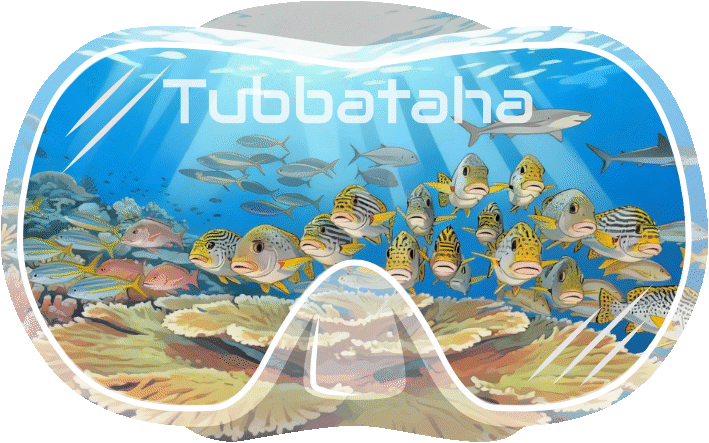
For this sticker, we wanted to capture the feeling of being completely outnumbered by marine life. We placed a school of Oriental Sweetlips right in the foreground because their bright yellow stripes and distinct "grumpy" faces are a favorite subject for photographers on these reefs. But Tubbataha is all about layers, so we didn't stop there. Behind the school, we illustrated a pristine table coral garden giving way to the deep blue drop-off, where we added the silhouettes of patrolling sharks and trevallies. It’s a design that celebrates the chaotic, colorful harmony of a perfectly healthy reef ecosystem.
Diving Tubbataha
Tubbataha Reefs Natural Park sits alone in the middle of the Sulu Sea, roughly ten hours by boat from Puerto Princesa, and it is the closest thing the Philippines has to genuinely untouched reef. A UNESCO World Heritage Site with no inhabitants beyond a ranger station, it is protected to a degree that shows the moment you get in the water: shark encounters on almost every dive, walls of jacks and barracuda, coral cover that looks like archive footage. Access is deliberately narrow. There is no land to stay on, so it is liveaboard-only, and the weather window is short — trips run roughly from mid-March to mid-June and not at all outside that. Berths sell out a year ahead. For divers who have seen reefs degrade over their diving lives, Tubbataha is a reminder of what the baseline used to be.
- Best time to dive
- Mid-March to mid-June only — the sole weather window
- Difficulty
- Intermediate to advanced — currents and open-water walls
- Water temperature
- 28–30°C
- Visibility
- 30–45m, exceptional
Top dive sites
- •North Atoll wall — Sheer drop-offs with constant shark traffic
- •Jessie Beazley Reef — Isolated reef, best odds of big schools
- •Washing Machine — Fast drift where currents converge
- •Delsan Wreck — Shark cleaning station on the sand
- •Malayan Wreck — South Atoll wall with turtles and pelagics
What you’ll see
Frequently asked questions
When can you dive Tubbataha?
Only between roughly mid-March and mid-June. Outside that window the Sulu Sea is too exposed for the crossing and the park is effectively inaccessible, so unlike most destinations there is no shoulder season to consider. Within it, April and May are generally regarded as the most settled. Because the season is so short and berths are limited to a handful of liveaboards, trips commonly sell out six to twelve months ahead — if Tubbataha is on your list, book far earlier than you would for anywhere else.
Do I need a liveaboard for Tubbataha?
Yes, there is no alternative. The park lies about 150 kilometres from Puerto Princesa in Palawan with no accommodation of any kind on the reefs beyond a park ranger station, so every visit is by liveaboard, typically on a five to seven night trip including the overnight crossing each way. Park fees are charged on top of the trip cost and go towards the ranger presence that keeps the reef in the condition it is in — which, given what you get to dive, is money well spent.
How experienced do I need to be for Tubbataha?
More than for a typical reef trip. The sites are open-water walls and reef corners with real current, sometimes fast drifts, and no shallow shelter to retreat to — the Washing Machine is named for exactly what it does. Most operators ask for Advanced Open Water and around 50 logged dives, and some request more. Good buoyancy, comfort with drift entries from a small boat, and confidence deploying an SMB are all genuinely useful here rather than nice-to-have.