Moalboal
South East Asia
Philippines
£2.50
Moalboal: The Resident Storm
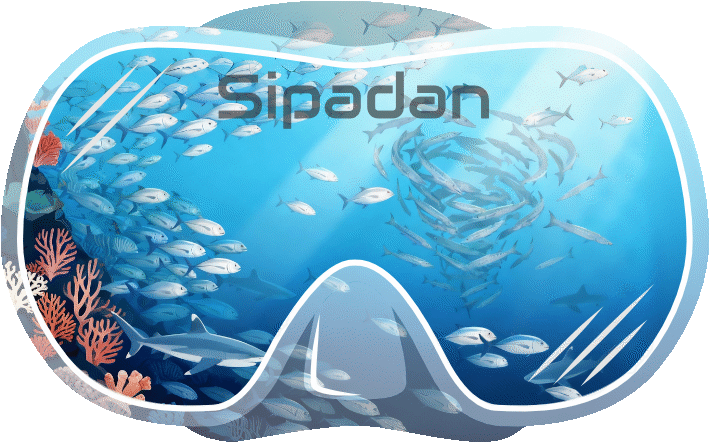
Moalboal is home to one of the most spectacular natural phenomena in the ocean, and it happens just 20 meters from the shore. At Panagsama Beach in Cebu, a resident school of millions of sardines congregates year-round along the reef drop-off. Unlike the famous South African migration that you have to chase, this is a permanent, living wall of fish that moves in perfect unison. Swimming into the middle of it feels like entering a living cave; the fish part to let you through and then close instantly behind you, often blocking out the sun completely.
Why We Chose This Sticker Design
The challenge with Moalboal is capturing the sheer scale of the school. We illustrated the sardines not as individual fish, but as a massive, swirling dark mass that dominates the water column, replicating the "tornado" shape they often form. To give a true sense of perspective, we included two divers in silhouette at the bottom, completely dwarfed by the millions of fish hovering above them. The deep blue background and light rays emphasize the depth and the atmospheric way the school filters the sunlight.
Diving Moalboal
Moalboal on Cebu's west coast has one of the most accessible spectacles in diving: a sardine run that sits permanently a short swim off Panagsama Beach, in water shallow enough that snorkellers see it too. Millions of sardines move as a single organism, splitting and reforming around divers, and unlike most baitball encounters it is there essentially year-round rather than for a few weeks. Beyond the sardines, Moalboal is an easy, affordable base: Pescador Island a few minutes offshore, turtles that graze the house reef reliably enough to be almost boring, and good macro for those who look. It is shore-diving country, which keeps costs low and makes it a favourite for divers who want to log a lot of dives without a boat schedule dictating their day.
- Best time to dive
- Year-round; driest and calmest roughly November to May
- Difficulty
- Easy — much of it is shore diving in shallow water
- Water temperature
- 27–29°C
- Visibility
- 15–30m
Top dive sites
- •Panagsama house reef — The sardine run, straight off the beach
- •Pescador Island — Wall diving and the "Cathedral" chimney
- •Turtle Point — Reliable green turtle encounters
- •Talisay Wall — Easy drift along healthy coral
- •Tongo Point — Macro life and dusk mandarinfish
What you’ll see
Frequently asked questions
Is the Moalboal sardine run there all year?
Effectively yes, which is what makes it remarkable. Unlike the seasonal sardine runs elsewhere in the world, the shoal at Panagsama has been a near-permanent fixture for years, sitting just off the beach in shallow water. Its exact position shifts along the reef and the density varies, but divers and snorkellers find it in essentially every month. Because it sits in five to fifteen metres of water only a short swim from shore, it is one of the few genuinely world-class encounters accessible without a boat.
Is Moalboal good for beginners?
Very. The sardine run and the house reef are shallow shore dives with minimal current, so newly certified divers can experience the headline attraction on their first days. Pescador Island involves a short boat ride and some wall diving where buoyancy matters more, and a few sites pick up current, but the overall profile is relaxed. Combined with low prices and easy access from Cebu City, it is a common choice for divers building experience after certification or continuing straight into Advanced.
How does Moalboal compare to Malapascua?
They are complementary rather than competing, and many divers do both on one Cebu trip. Moalboal is easy, shallow, shore-based diving built around the sardine run and turtles, ideal for relaxed logging and newer divers. Malapascua, at the far northern tip of the island, is about one specific pre-dawn deep dive for thresher sharks and suits more experienced divers. The overland journey between them takes most of a day, so plan several nights in each rather than trying to day-trip.